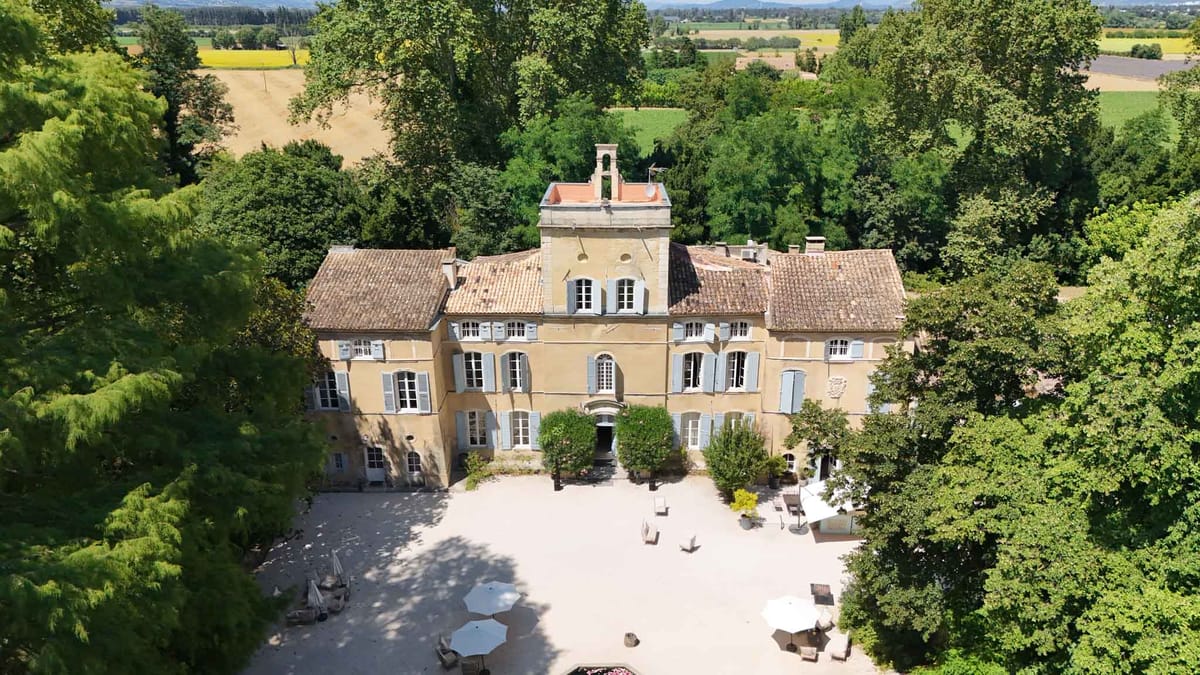
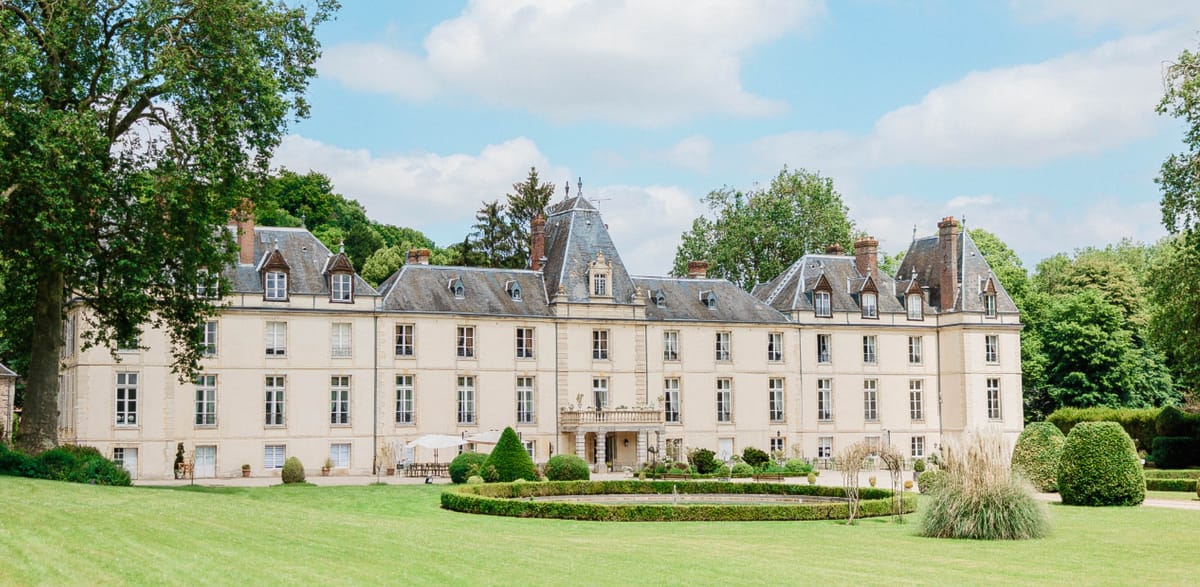
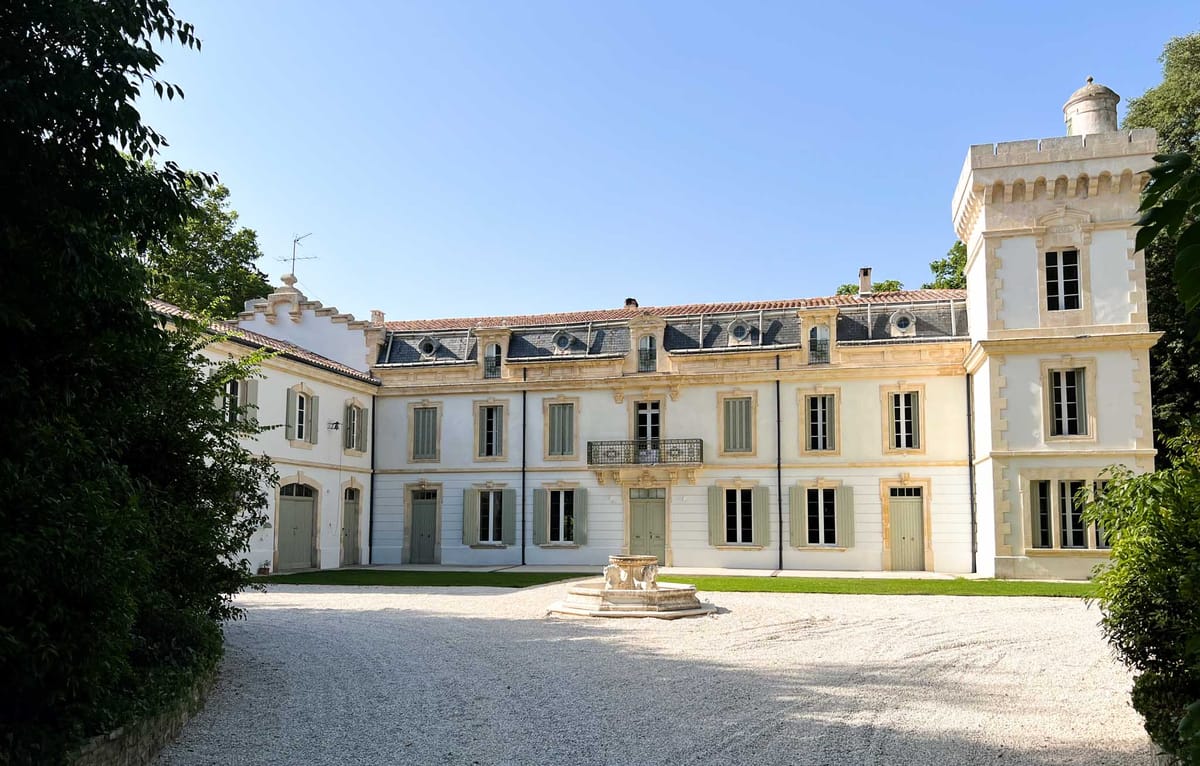
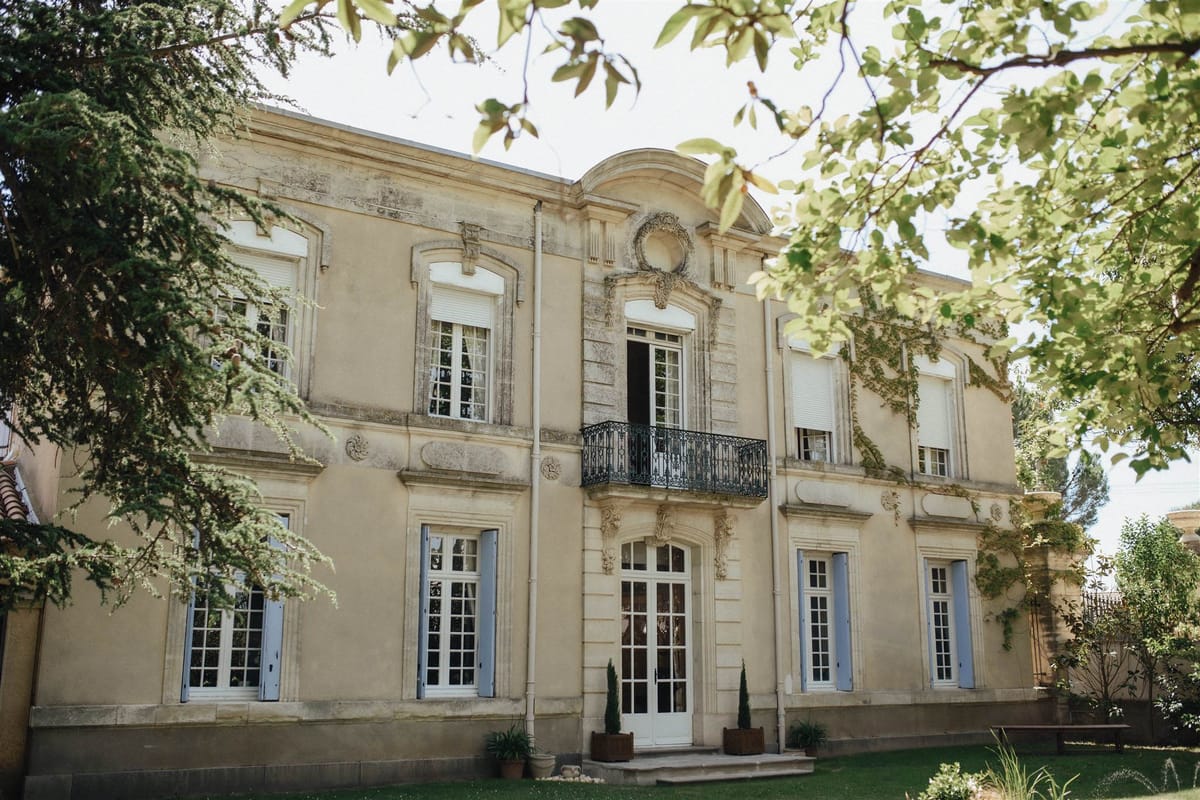
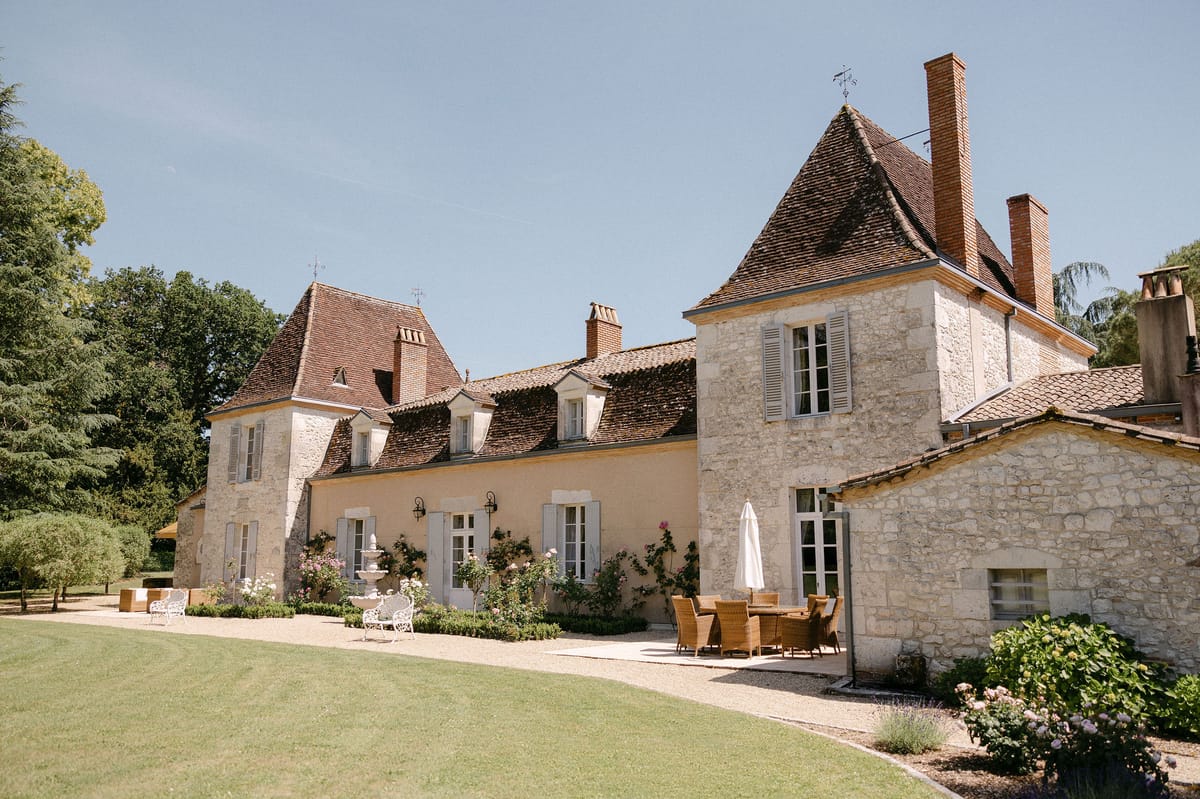
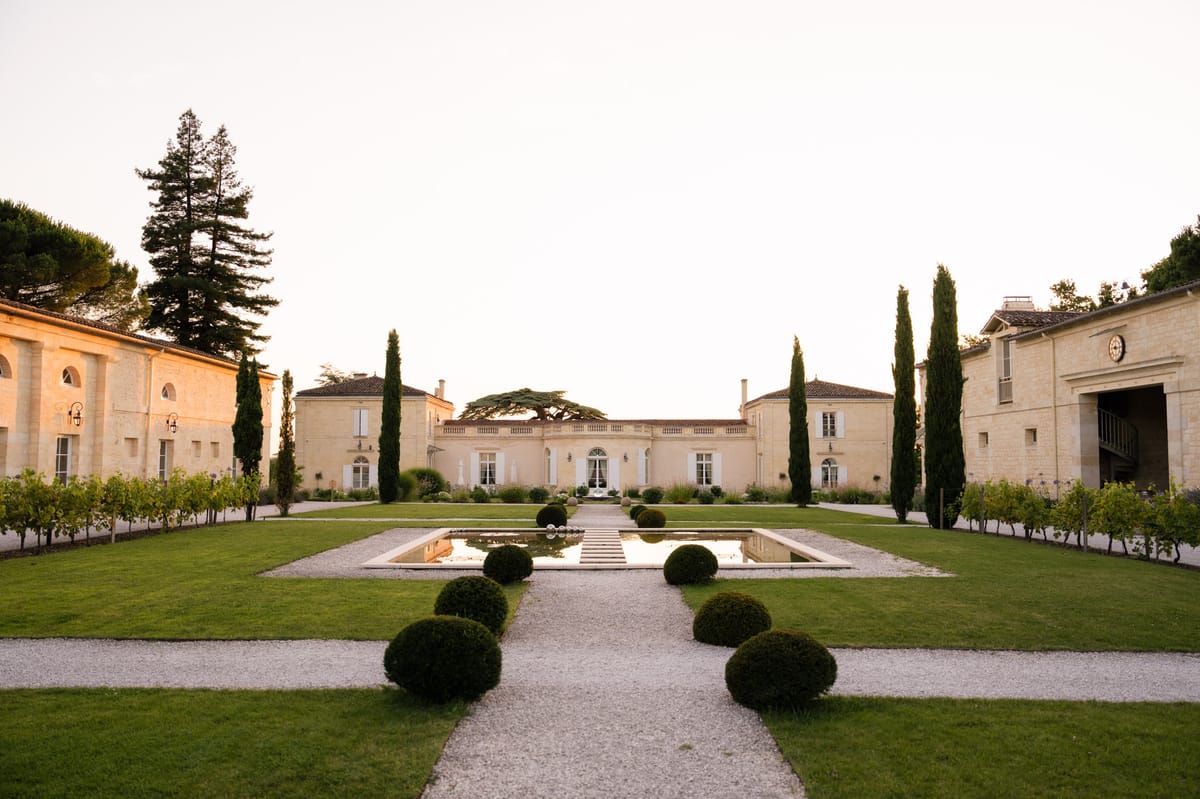
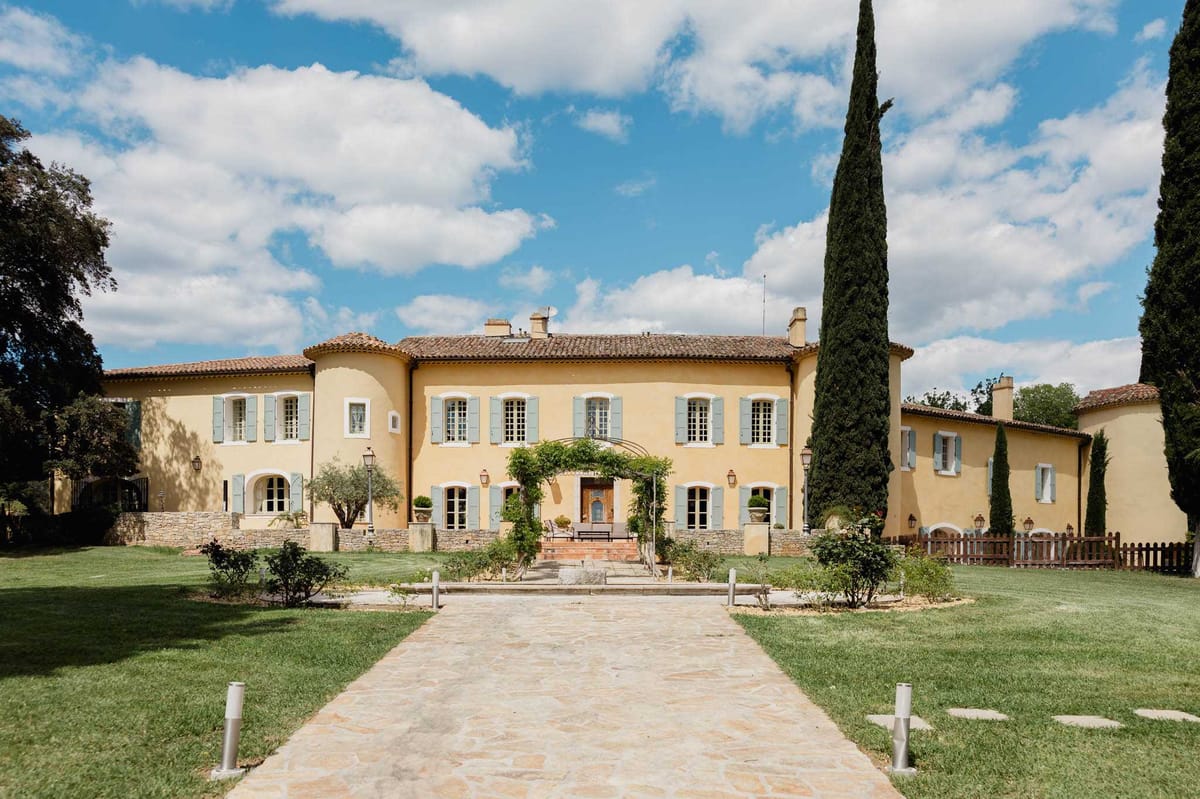
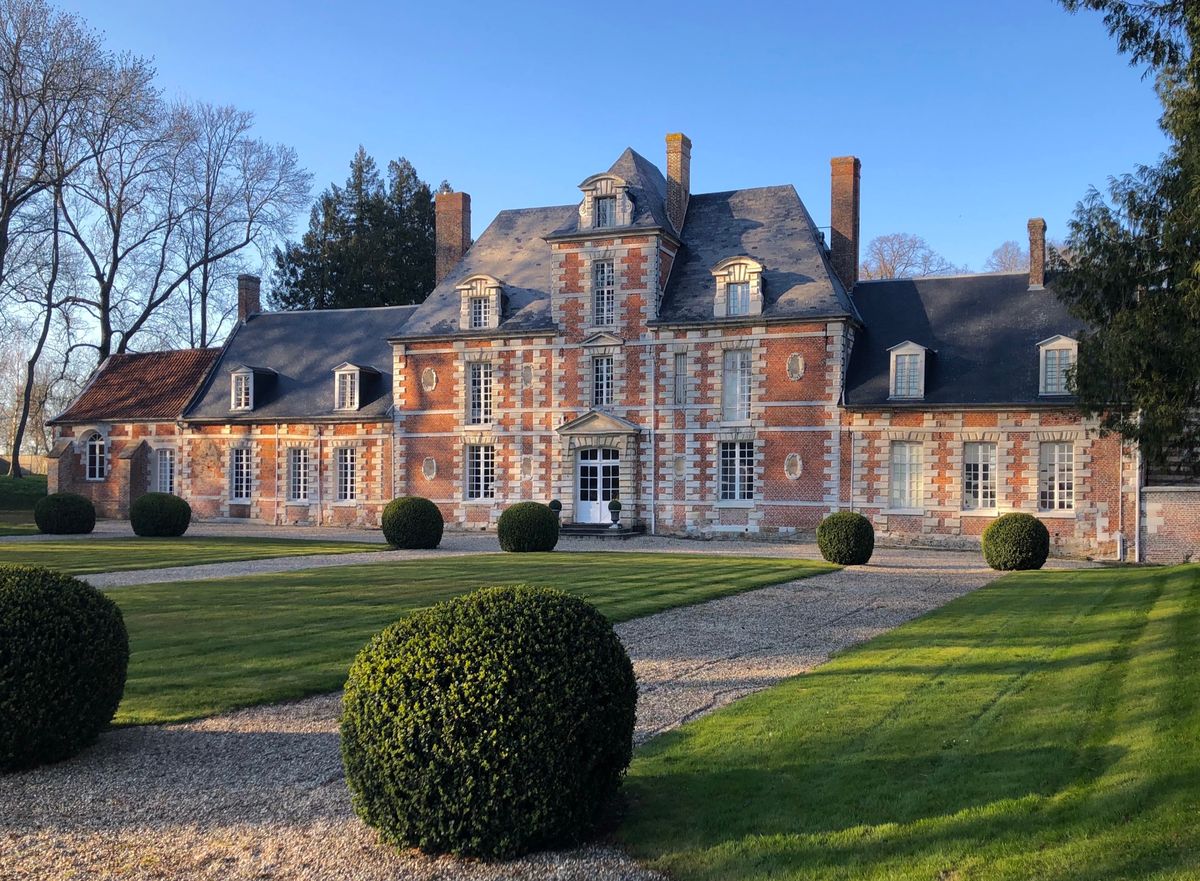
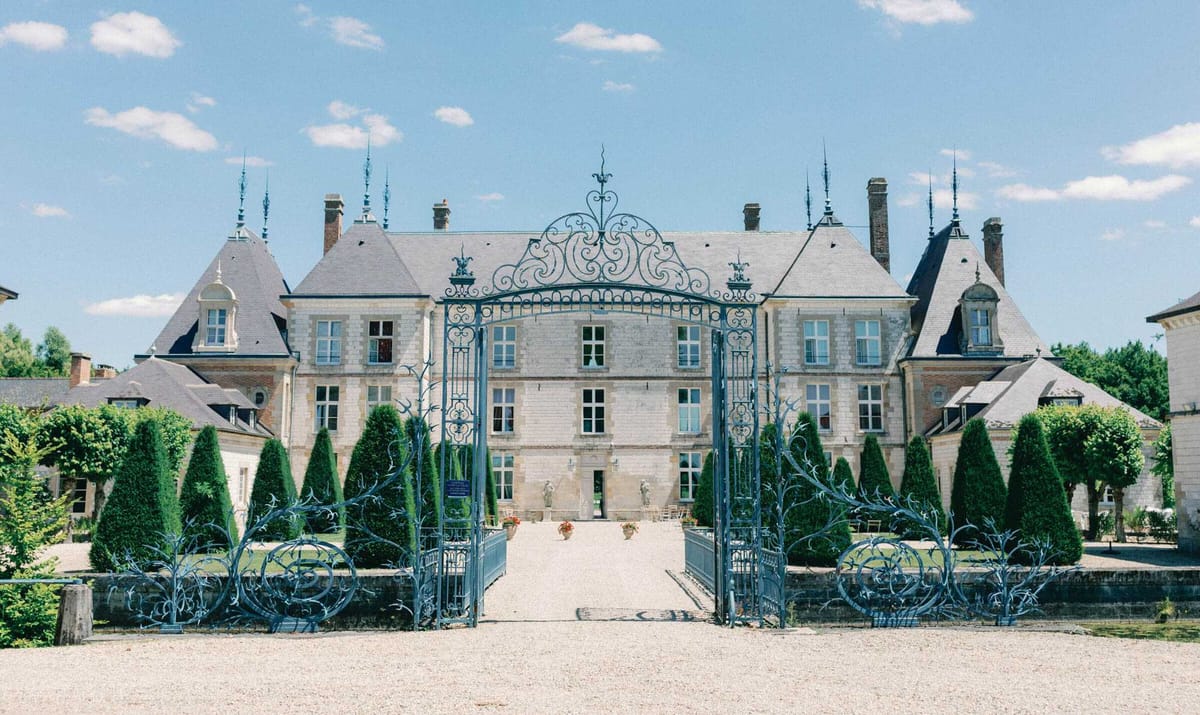
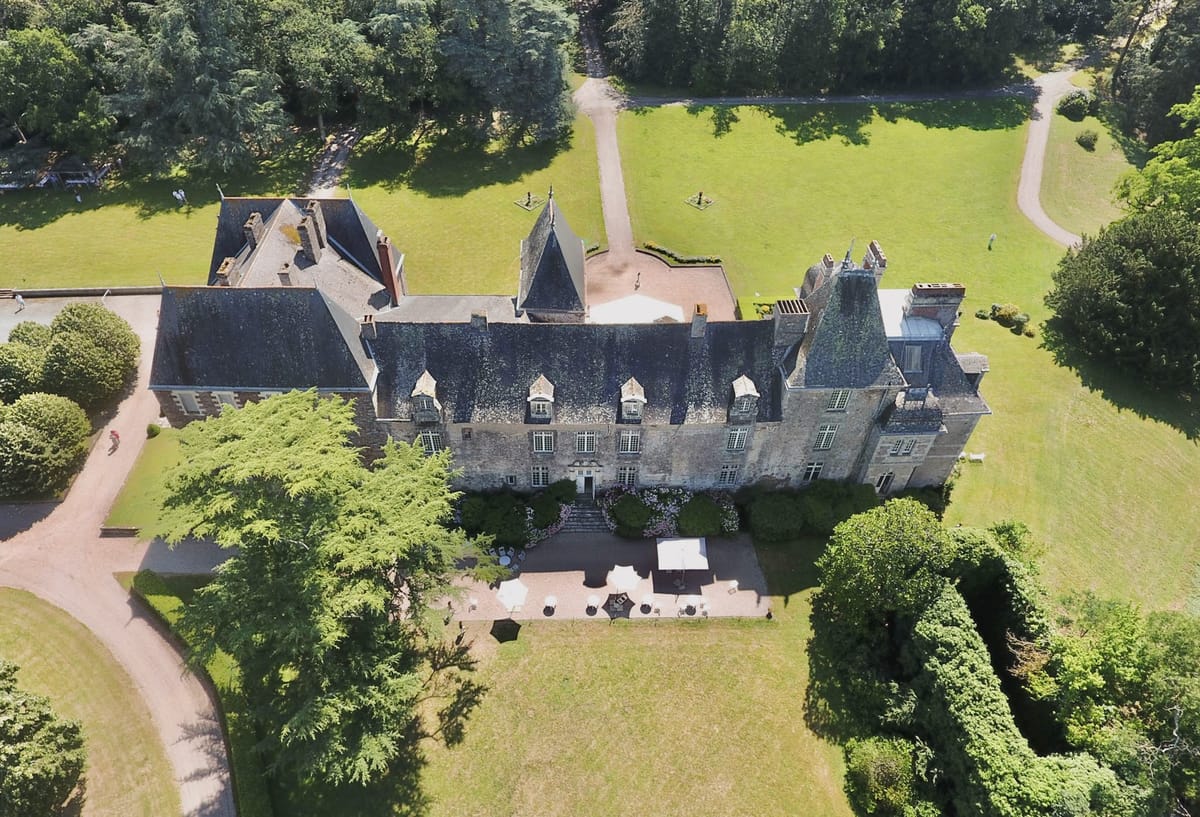
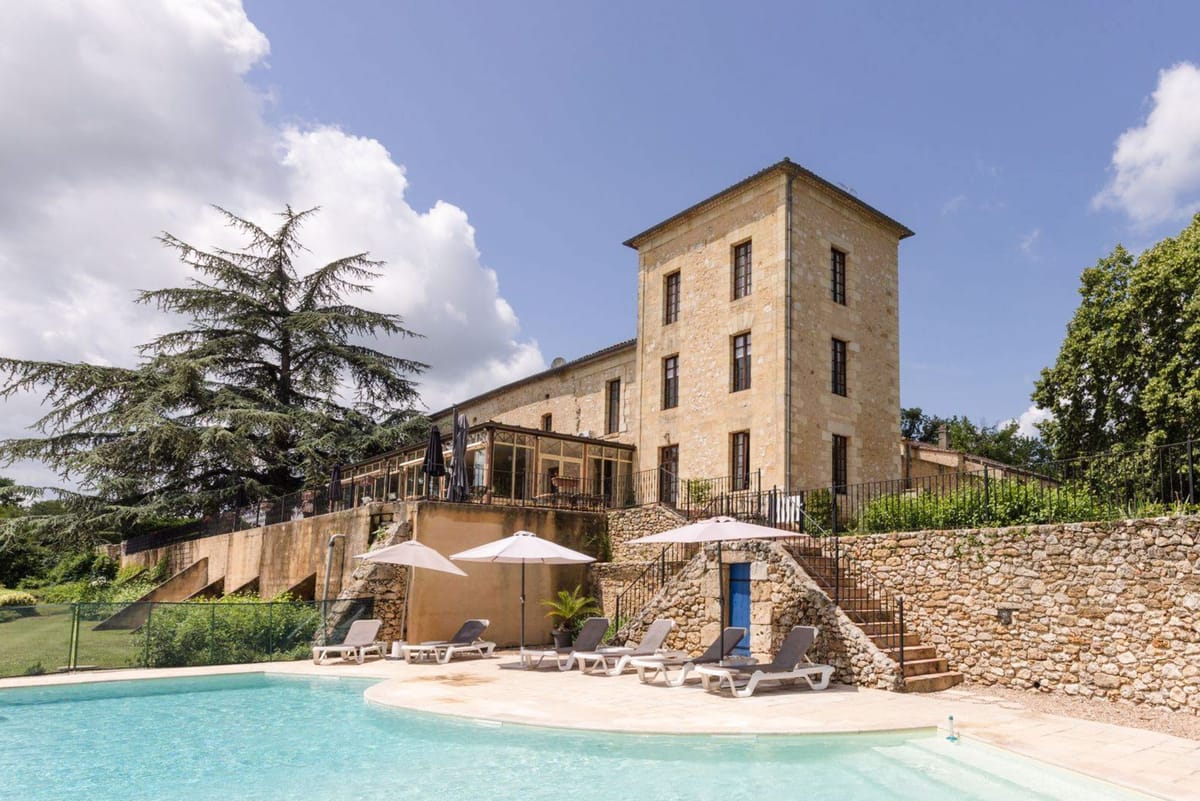
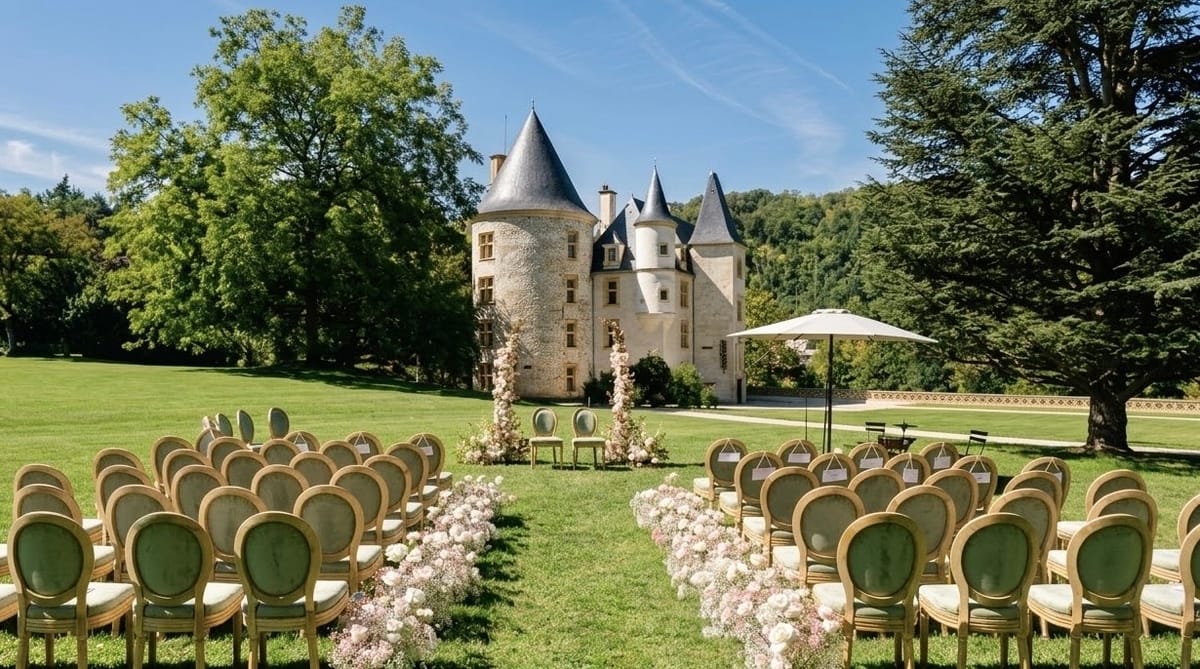
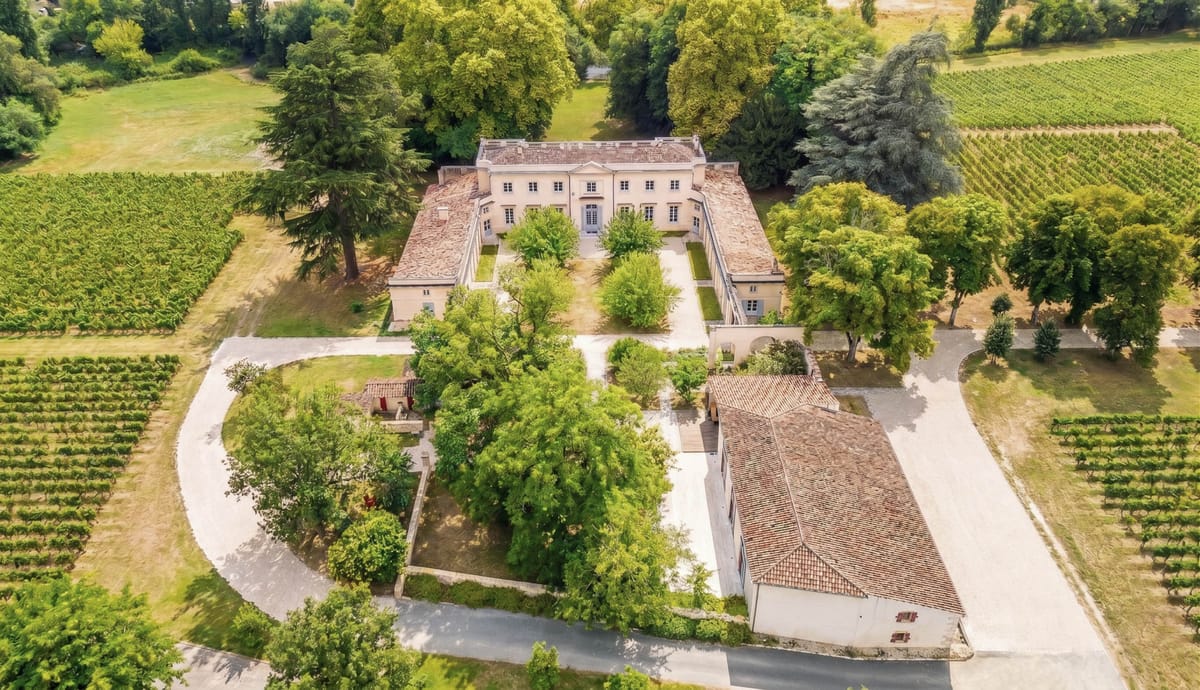
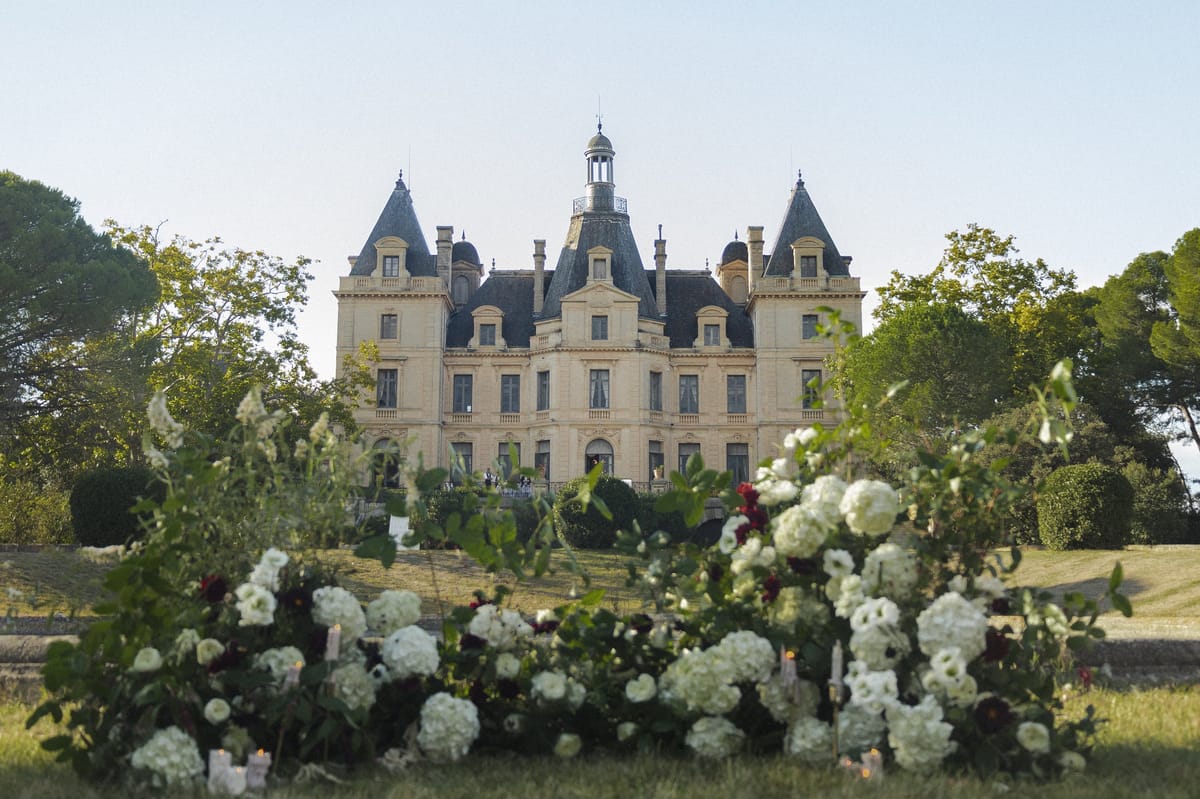
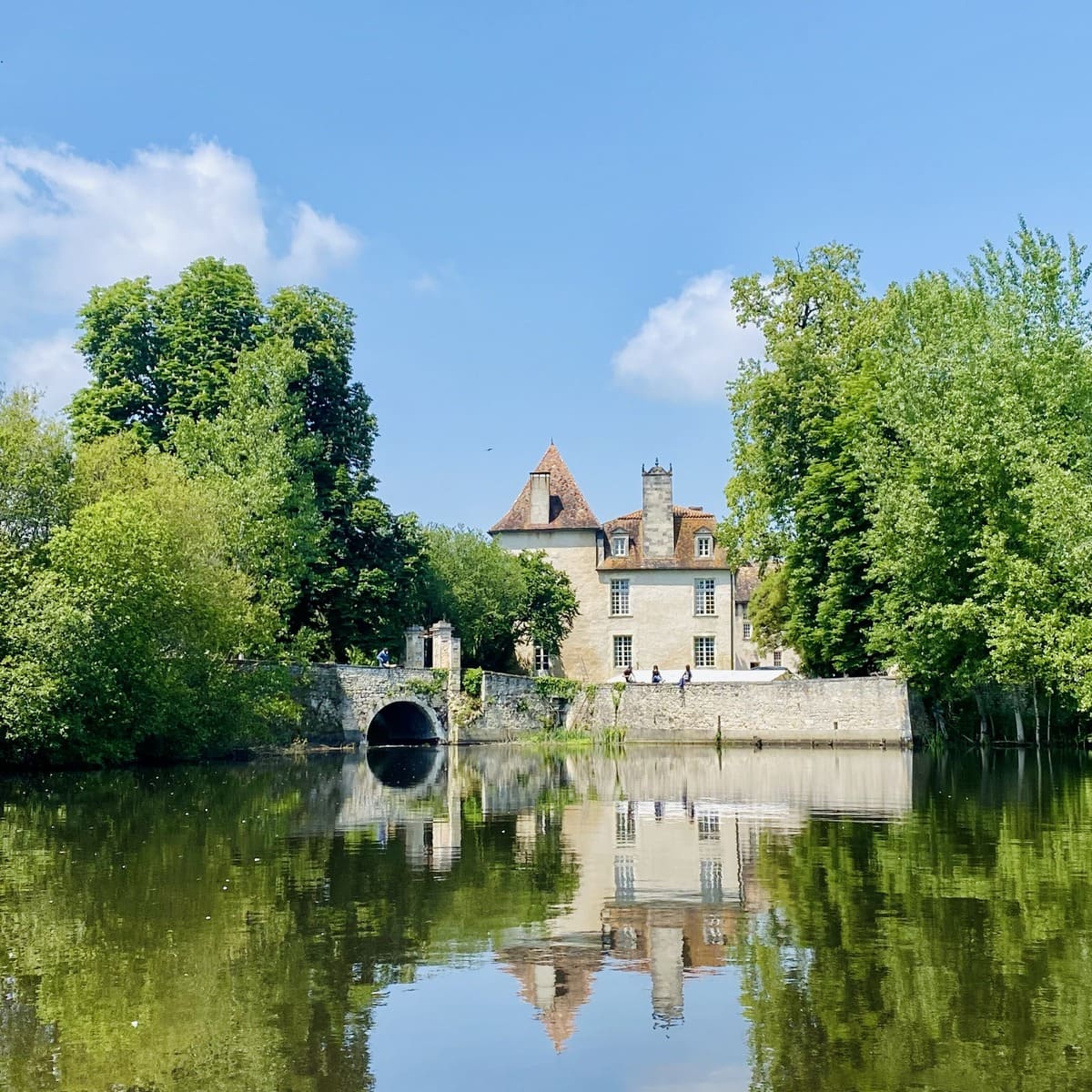
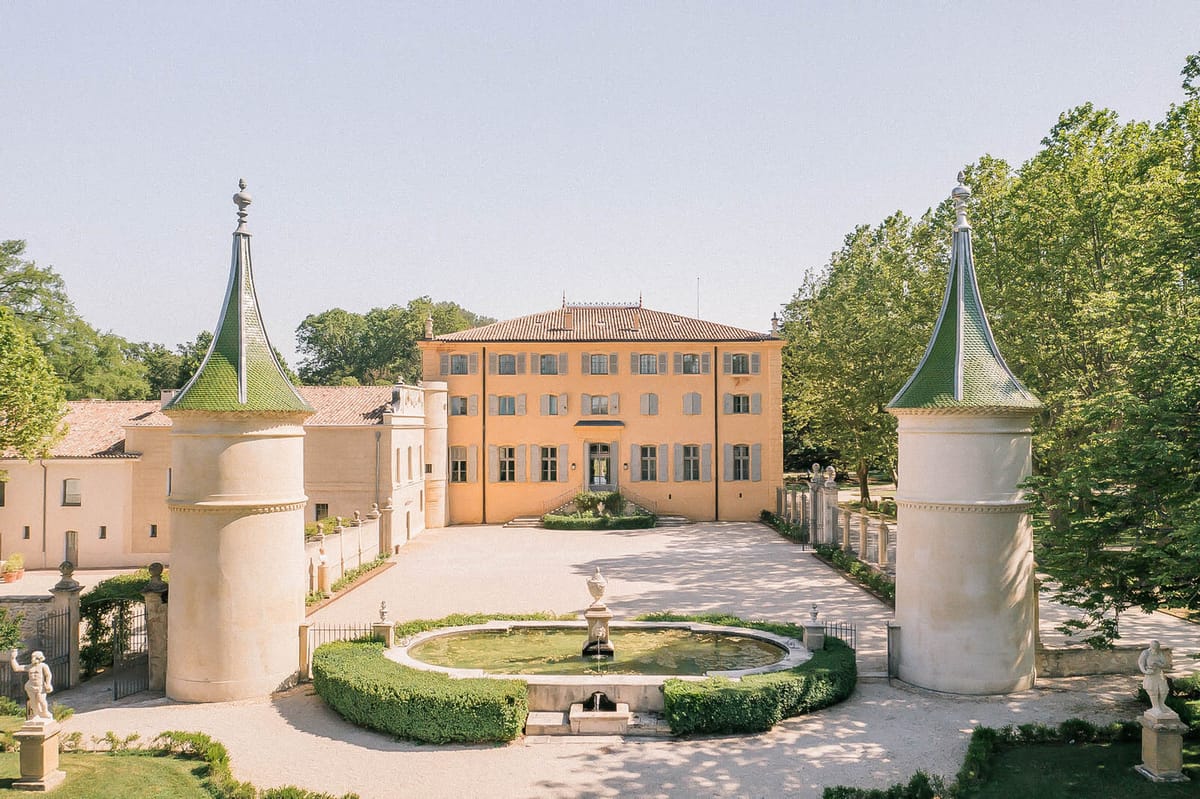
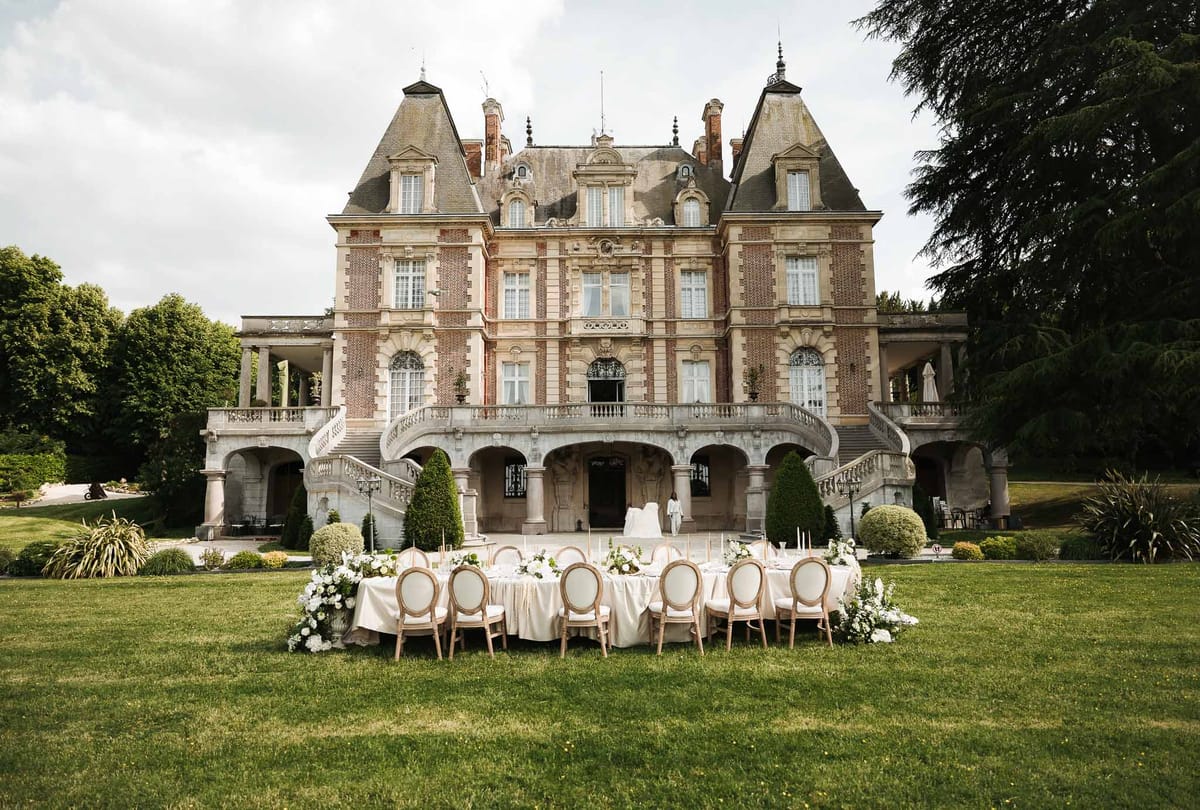
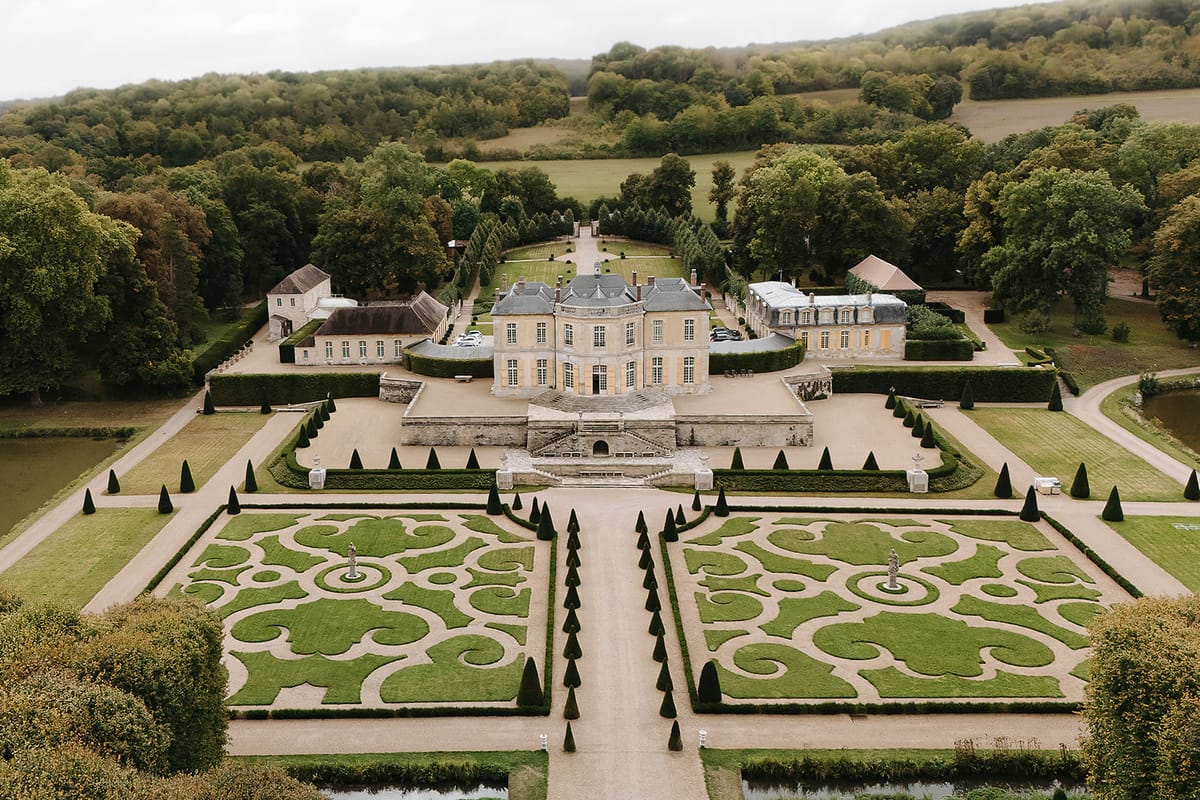
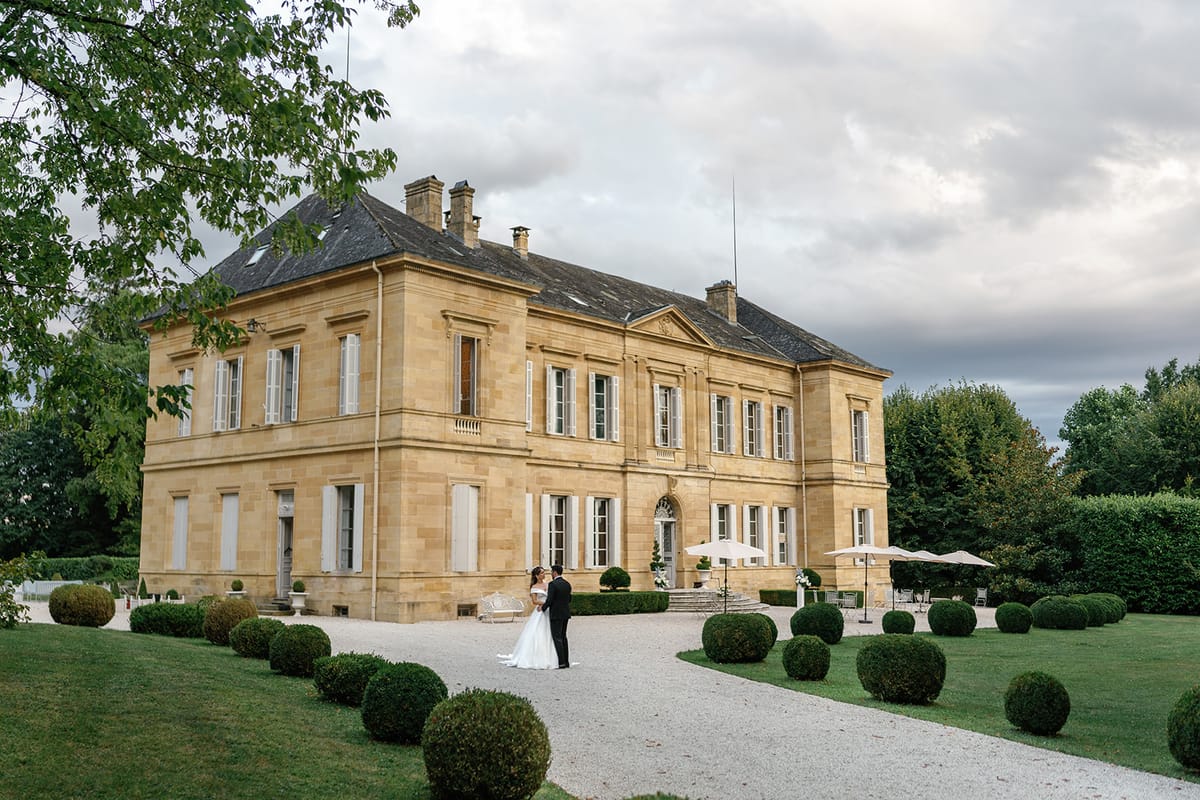
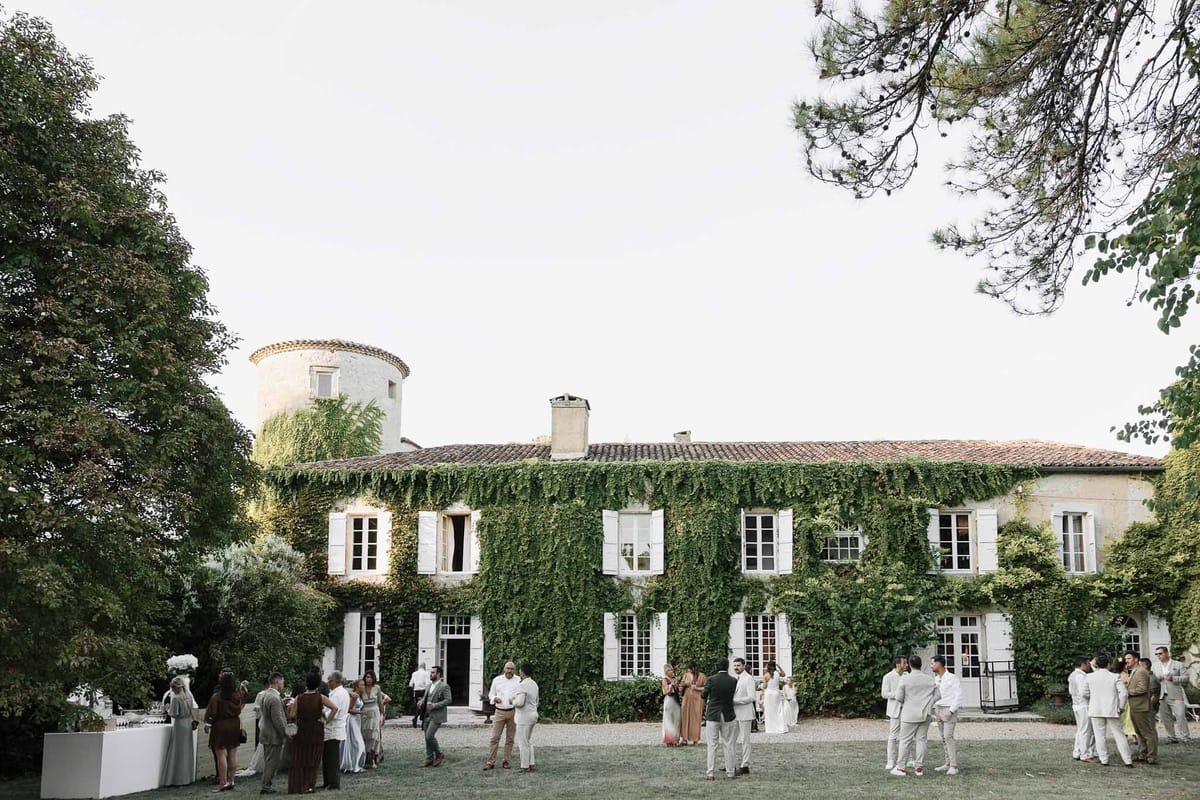
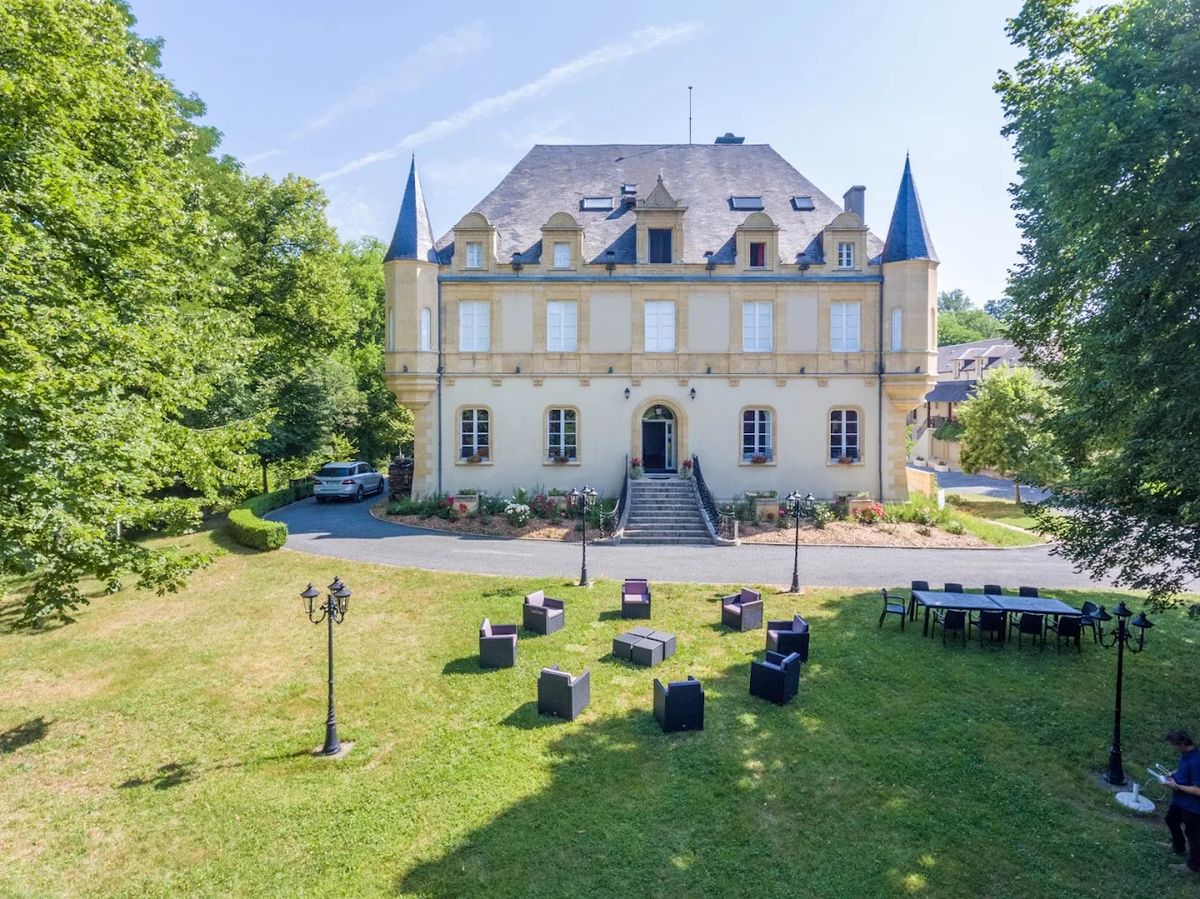
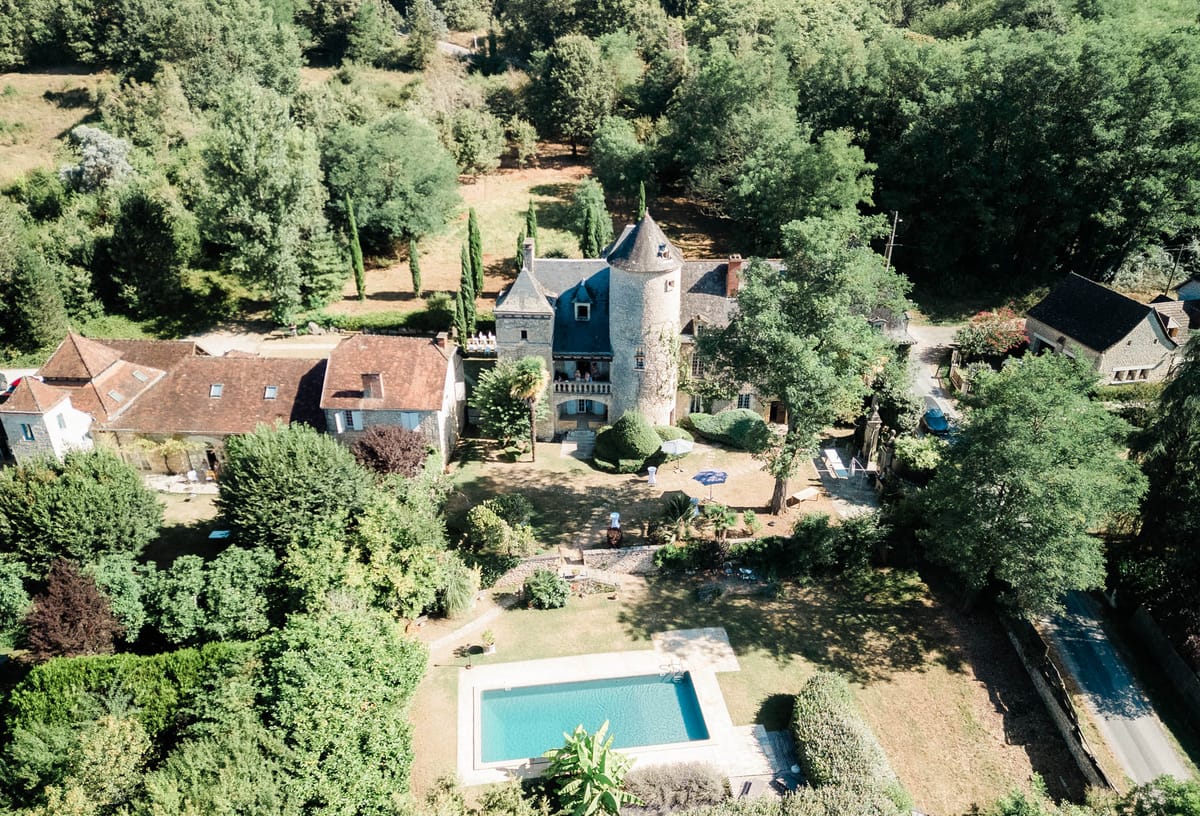
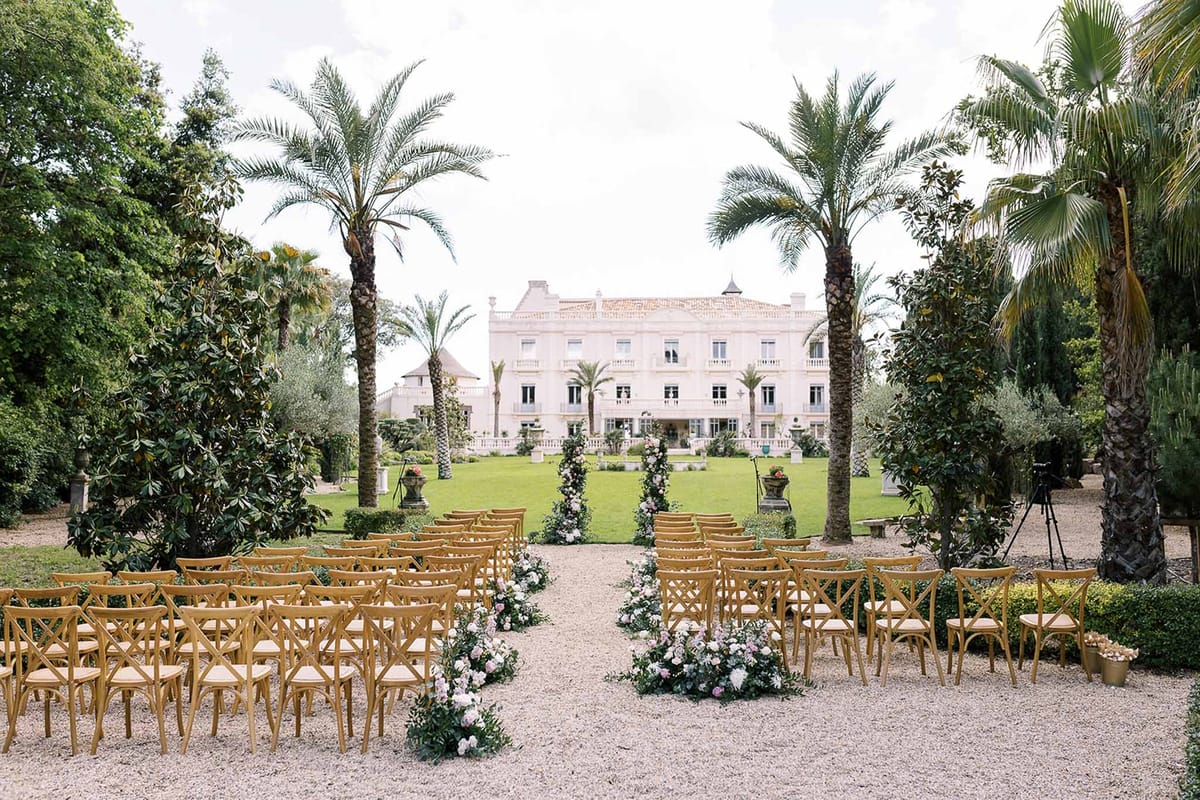
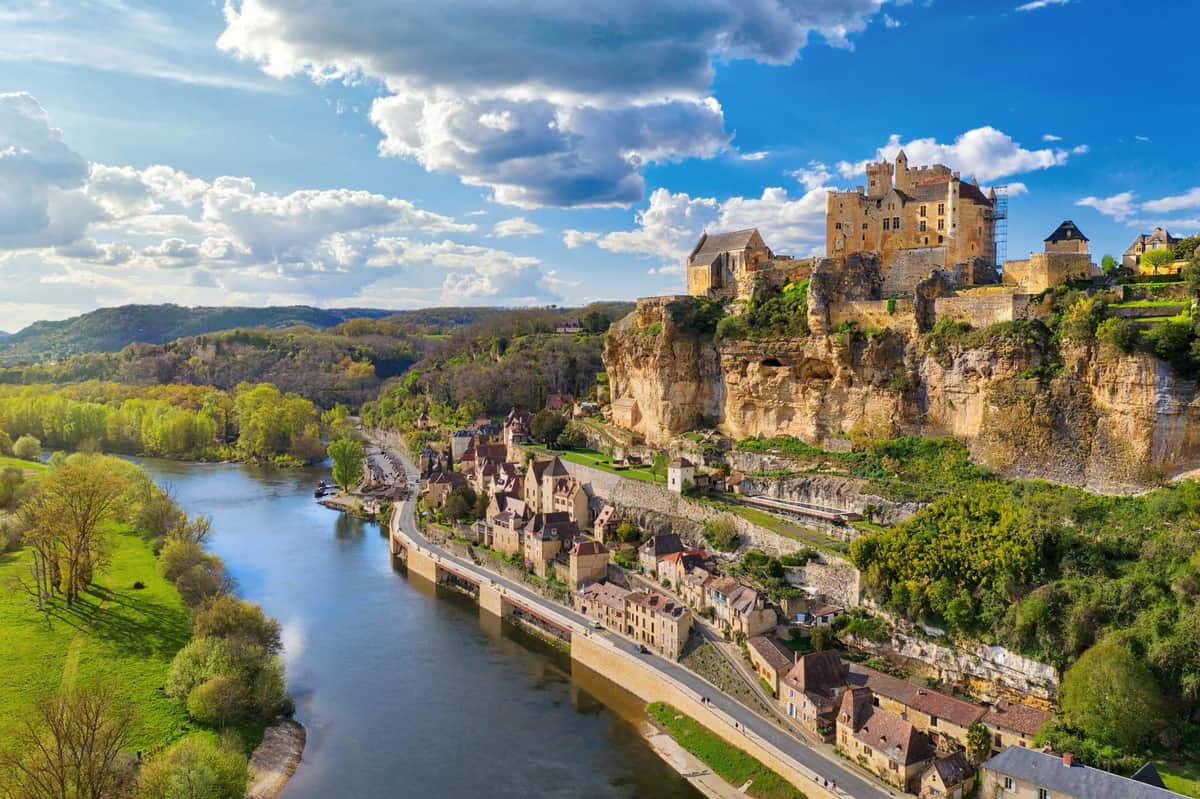
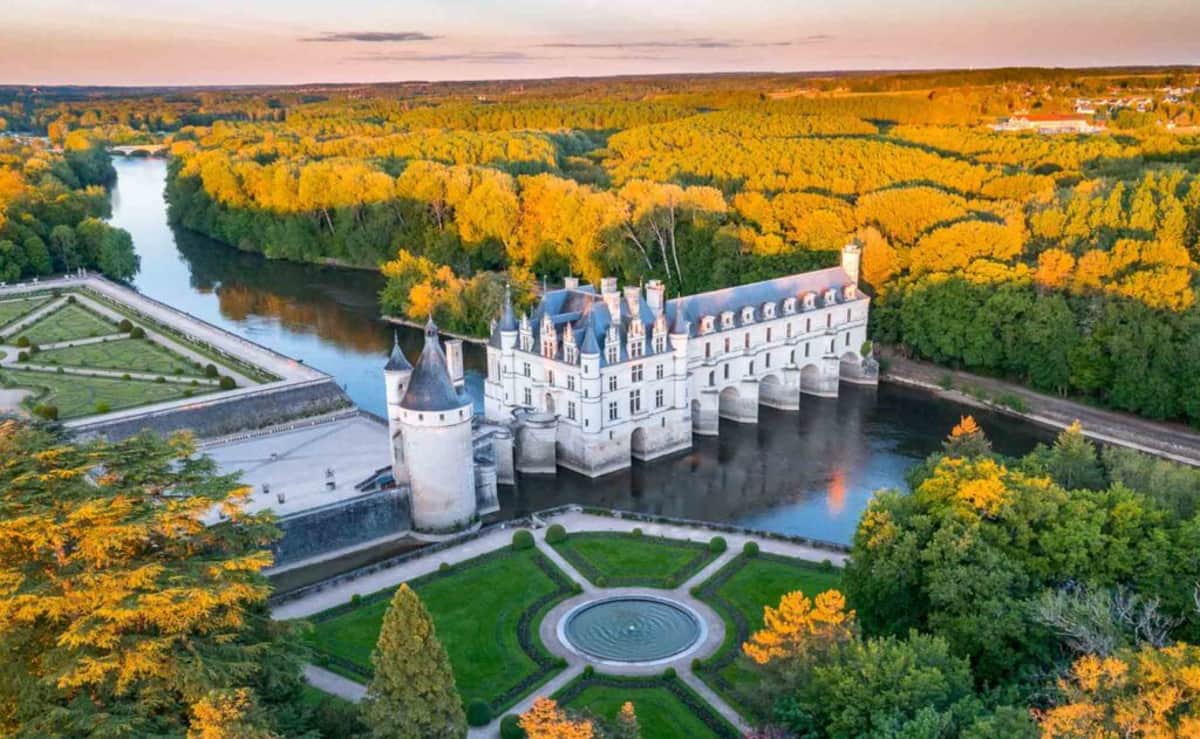
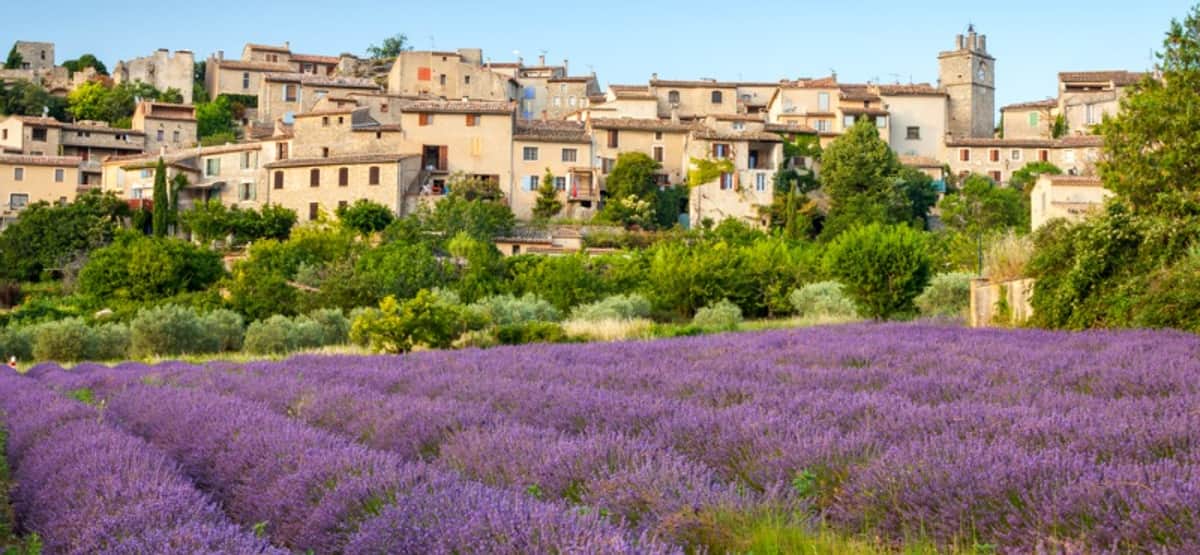
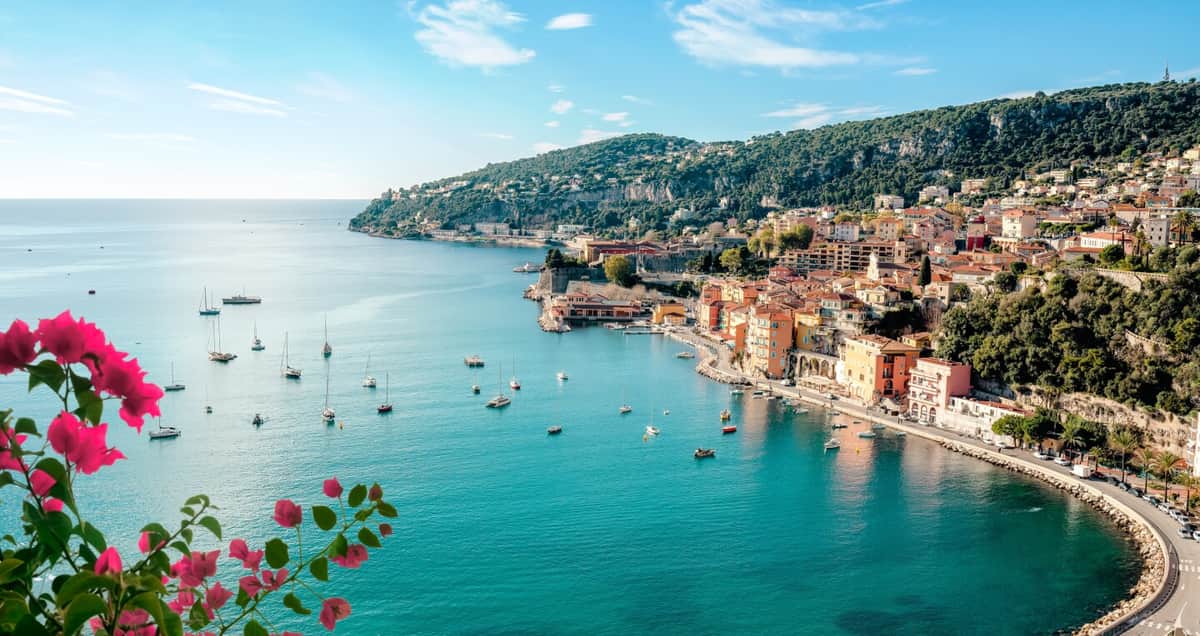
A château wedding in France means marrying on a private historic estate, where a grand country house and its formal grounds become yours for the celebration. The word château describes a register more than a building type: it signals a dressed, ceremonial setting, with reception rooms, ornamental gardens, and the architecture of a former noble or wine-growing residence. That register is what sets a château apart from a domaine, a mas, or a manoir, which feel more lived-in and working. Couples drawn to a château want that formality and sense of occasion: a sweeping façade for the ceremony, garden terraces for dinner, and interiors that carry their own history. Estates in this class are almost always hired on a whole-estate basis, so the property hosts one wedding at a time rather than several events at once.
Editor's Tip
French communes can impose a noise curfew on outdoor music and amplified sound, typically requiring it to move indoors after a set hour once the countryside quiets down. Confirm your château's specific curfew and any neighbour-notification requirement directly with the venue before booking a live band or a late reception.
In brief
A French château wedding is usually a whole-estate celebration over 2 to 3 days: the couple hires a historic château and its grounds exclusively, and holds the ceremony, dinner, and overnight stays on site. Couples marrying from abroad hold a symbolic ceremony at the château and complete the legally binding civil marriage in their home country. The cost depends mostly on whether you hire the estate dry or all-inclusive, and on the catering model.
Key facts at a glance
Whole-estate hire. Most châteaux are hired whole-estate: the house and grounds are yours alone for the wedding, often across a long weekend, with no shared or overlapping events.
Guest capacity. Grand reception rooms, gardens, and terraces suit everything from intimate gatherings to celebrations of several hundred guests.
On-site accommodation. Most sleep the wedding party on site in restored period bedrooms, with nearby hotels and gîtes for larger guest lists.
What it costs. Hire varies with the estate's size, the season, and whether it is taken dry-hire or all-inclusive; after the venue, catering is usually the largest cost.
Grounds and features. Many sit in formal gardens or parkland, with features such as a swimming pool, a working vineyard, or an on-site chapel.
€18,000PricingFrom €18,000Peak season (June-September) exclusive castle hire with accommodation for up to 49 guests, 2-night minimum•Weekday Stay (1 night, 33 guests) — €15,100Exclusive use · Accommodation for 33•Weekend Stay (3 nights, 49 guests) — €36,200Exclusive use · Accommodation for 49 guests · 3 nights
€8,000PricingFrom €8,000 · All-inclusivePeak season (June-September) exclusive venue dry hire for up to 120 guests, 2-night minimum•Venue Dry Hire — €8,000•All-Inclusive Wedding Package — €30,000
€5,450PricingFrom €5,450Peak season (June-September) exclusive chateau hire for 2 days with 1 night's accommodation for up to 26 guests•3-Day / 2-Night Stay — €13,85012 rooms accommodation · Exclusive use of chateau•4-Day / 3-Night Stay — €15,95012 rooms accommodation · Exclusive use of chateau•4-Day / 3-Night Stay (Peak) — €19,10012 rooms accommodation · Exclusive use of chateau
€19,119PricingFrom €19,119 · All-inclusivePeak season (June to September) 3-night wedding weekend with the whole estate, in-house chef and planner, plus on-site guest accommodation, which is part of the minimum package but priced separately.
€14,000PricingFrom €14,000 · Hire + packagesPeak season (June-September) exclusive 200-hectare estate hire with accommodation for 28 guests, 2-night minimum
€11,500PricingFrom €11,500 · Hire + packagesPeak season (June-September) exclusive rental for up to 130 guests•Exclusive Wedding Weekend — €11,500Exclusive use of the estate for 2 days · Accommodation for up to 30 guests for 1 night · A dedicated wedding coordinator · +2 more•Premium Wedding Weekend — €12,500Everything in the Exclusive Wedding Weekend · Exclusive use of the estate for 3 days · Accommodation for up to 30 guests for 2 nights · +1 more•Royal Wedding Weekend — €15,000Everything in the Premium Wedding Weekend · An in-house DJ · Use of the historic chapel for the ceremony · +1 more
€10,355PricingFrom €10,355 · Hire + packagesPeak season (June to September) multi-day venue hire with in-house catering, 2-night minimum stay•2-Night Wedding Package — €10,355Multi-day exclusive use (2 nights) · Catering on all days with seasonal and local products · Night before meal for all guests staying on site · +2 more•3-Night Wedding Package — €11,355Multi-day exclusive use (3 nights) · Catering on all days with seasonal and local products · Night before meal for all guests staying on site · +2 more
€17,400PricingFrom €17,400 · Hire + packagesStarting at €17,400 for the smallest wedding (up to 30 guests): €4,800 wedding package plus €12,600 for the 3-night chateau package (11-bedroom chateau estate, breakfast included). Additional nights at a discount rate of €2,800. Wedding package is tiered by guest count: €4,800 (up to 30), €6,200 (31 to 60), €7,600 (61 to 90), €9,000 (91 to 120 max). Optional add-on accommodation: Relais du Château annex (€1,400/night, 2-night min), Ostal Cassinia and Le Casteras cottages (€800/night each, booked separately).•Wedding Package - Up to 30 guests — €4,800Wedding manager assistance from booking through wedding day · Vendor recommendation and coordination · Exclusive use of reception spaces (indoor and outdoor) · +5 more•Wedding Package - 31 to 60 guests — €6,200Wedding manager assistance from booking through wedding day · Vendor recommendation and coordination · Exclusive use of reception spaces (indoor and outdoor) · +5 more•Wedding Package - 61 to 90 guests — €7,600Wedding manager assistance from booking through wedding day · Vendor recommendation and coordination · Exclusive use of reception spaces (indoor and outdoor) · +5 moreSee full pricing →
€9,000PricingFrom €9,000From EUR 9,000 for a one-night weeknight privatisation (Tuesday to Wednesday) with on-site accommodation. The full Friday-to-Monday weekend, also including accommodation, is EUR 16,400.
€11,500PricingFrom €11,500 · All-inclusivePeak season (June-September) exclusive estate hire for up to 350 guests, 2-night minimum stay•Weekend Estate Hire — €11,500Exclusive use of the estate from Friday 4pm to Sunday 5pm · Use of the grounds for ceremony · Access to the chapel for intimate ceremony (30 people) · +5 more
€7,225PricingFrom €7,225 · Venue hire only2027 rate for midweek hire in low season. Weekend hire starts at €8,500 in 2027 and €9,950 in 2028.•Third night (2027) — €1,600A 20% discount on the nightly rate · Exclusive use of the estate and its accommodation for a further night•Weekday hire, May to September (2027) — €8,455Sole use of the chateau grounds and terrace · Reception hall from 10:00 the day before, with adjoining catering preparation area · Accommodation for 27 guests over 2 nights · +5 more•Weekend hire, May to September (2027) — €9,950Sole use of the chateau grounds and terrace · Reception hall from 10:00 the day before, with adjoining catering preparation area · Accommodation for 27 guests over 2 nights · +5 moreSee full pricing →
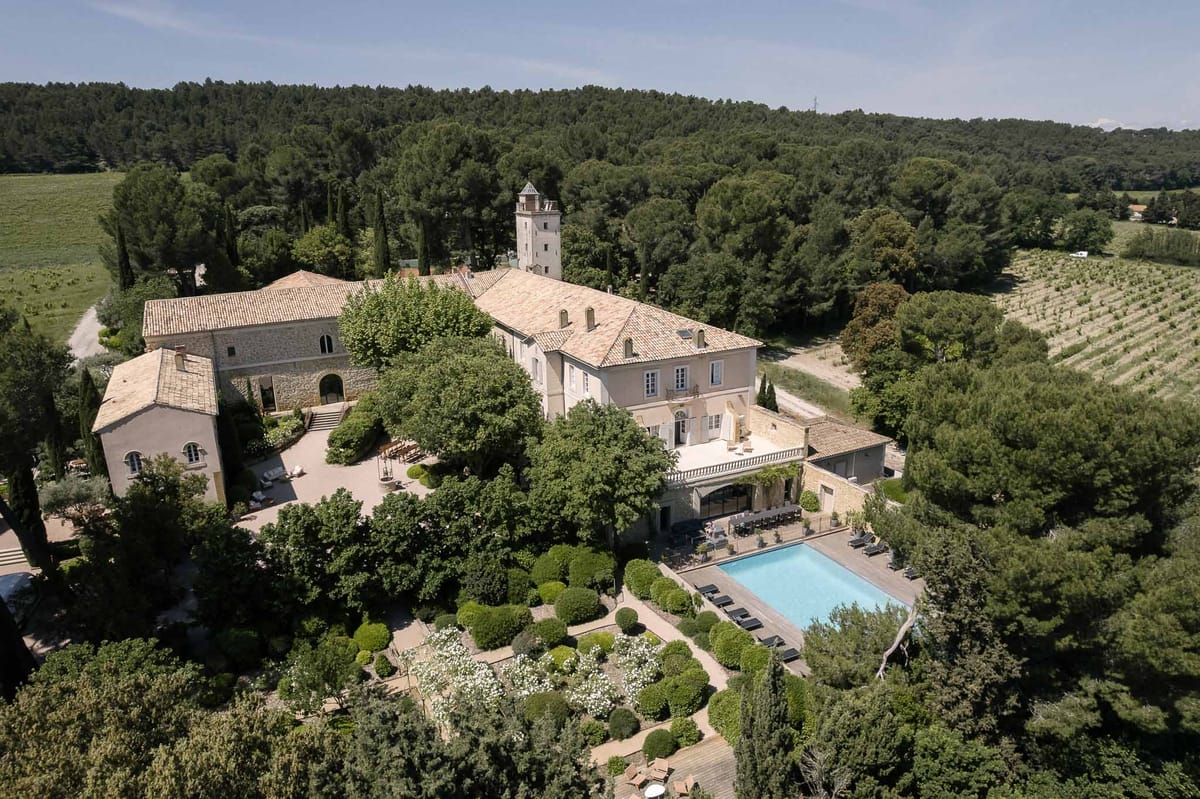
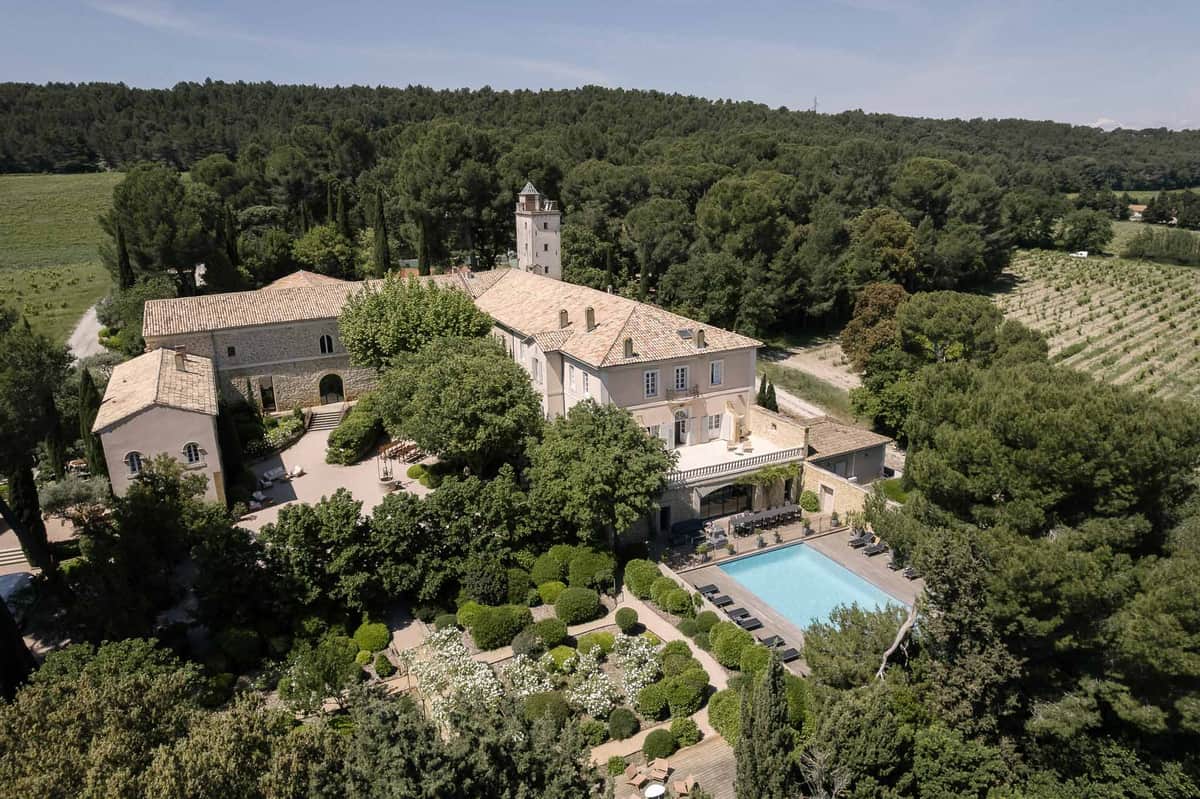
Château La Tour Vaucros draws its historical pedigree from the most distinguished source: the 17th-century tower that gives the estate its name once watched over the Comtat Venaissin, the papal territory that governed this corner of Provence for five centuries. Six stone buildings, including a former chapel, preserve original features, Provençal tiles, a bread oven, fireplaces, and a spiral staircase, that define the estate's architectural character as something accumulated across four centuries rather than restored for events. The Grand Reception Room and Salon d'Été provide formal indoor spaces, while the outdoor theatre, vine terrace, and path beneath age-old pines each offer different ceremony and cocktail settings across the grounds.
Twenty-three bedrooms sleep 49 guests with capacity for 250, no curfew, and a position near Avignon that places the estate within 25 minutes of TGV and direct connection to Paris in under three hours. Lavender, olive groves, and pink laurels frame the Provençal landscape that surrounds the buildings.
Why We Love It
A 17th-century Provençal tower estate where pine alleys, lavender gardens, and stone architecture create an atmosphere rooted in the south.
Max Guests
250
Sleeps
49
Chapel
No
From €18,000PricingFrom €18,000•Weekday Stay (1 night, 33 guests) — €15,100Exclusive use · Accommodation for 33•Weekend Stay (3 nights, 49 guests) — €36,200Exclusive use · Accommodation for 49 guests · 3 nights/ venue hire
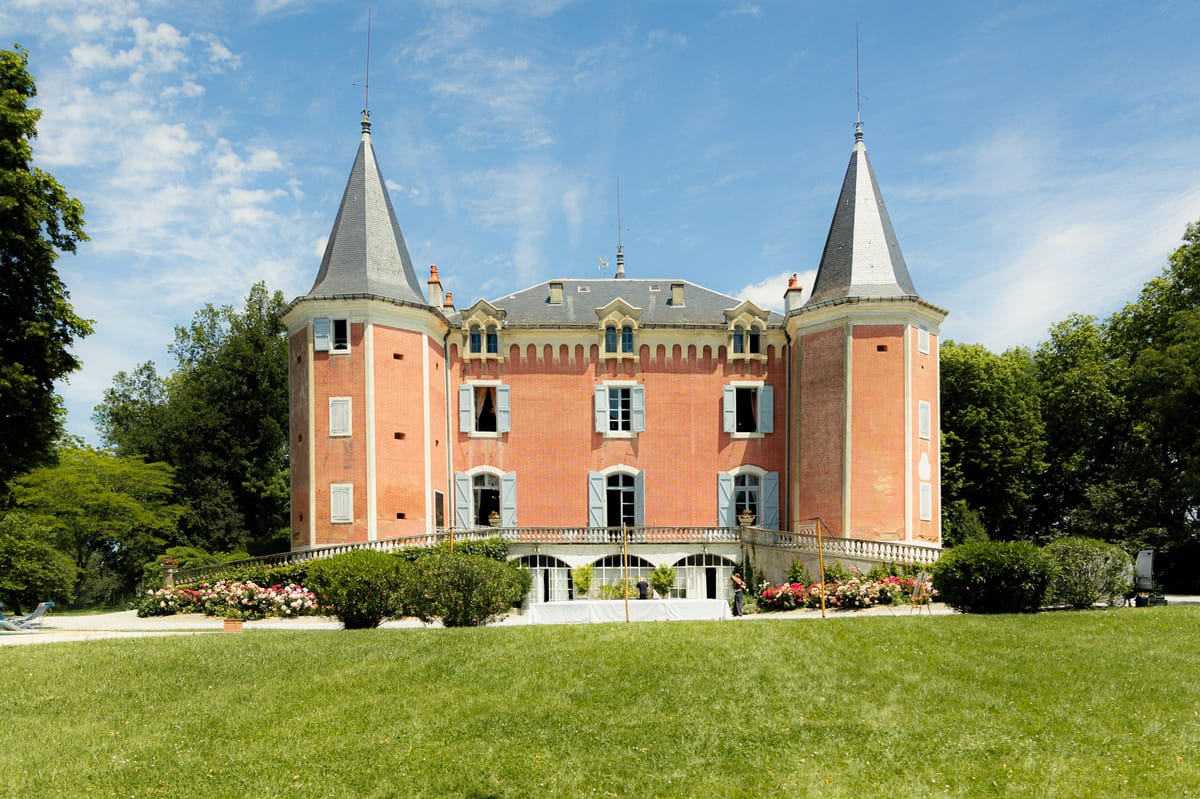
Among all the châteaux, Château de Garrevaques carries the deepest human history: 18 unbroken generations of the same family since the 15th century, with every layer of that continuity visible in the coral-pink washed façade, blue shutters, double staircase, and salons classified as French Historic Monuments for their rare Dufour wide-mural wallpaper depicting Cupid and Psyche. The château survived the Wars of Religion, was burned during the Revolution, and was requisitioned in WWII, with family archives from each period still held on the estate. This is not managed heritage but lived heritage, and owner Caroline Combes-Pouzet, who plans every wedding personally, brings a storyteller's understanding of that history to each celebration.
The 550-year-old oak in the 6-hectare park is officially listed as a Remarkable Tree of France. Twenty bedrooms sleep 15 guests on-site, and the château seats 120 for a wedding, with capacity for up to 260 across the broader estate. Toulouse-Blagnac Airport is 45 minutes away.
Why We Love It
Eighteen generations of family ownership, salons classified as historic monuments, and a 550-year-old listed oak create irreplaceable château heritage.
Max Guests
120
Sleeps
15
Chapel
No
From €8,000PricingFrom €8,000 · All-inclusive•Venue Dry Hire — €8,000•All-Inclusive Wedding Package — €30,000/ venue hire
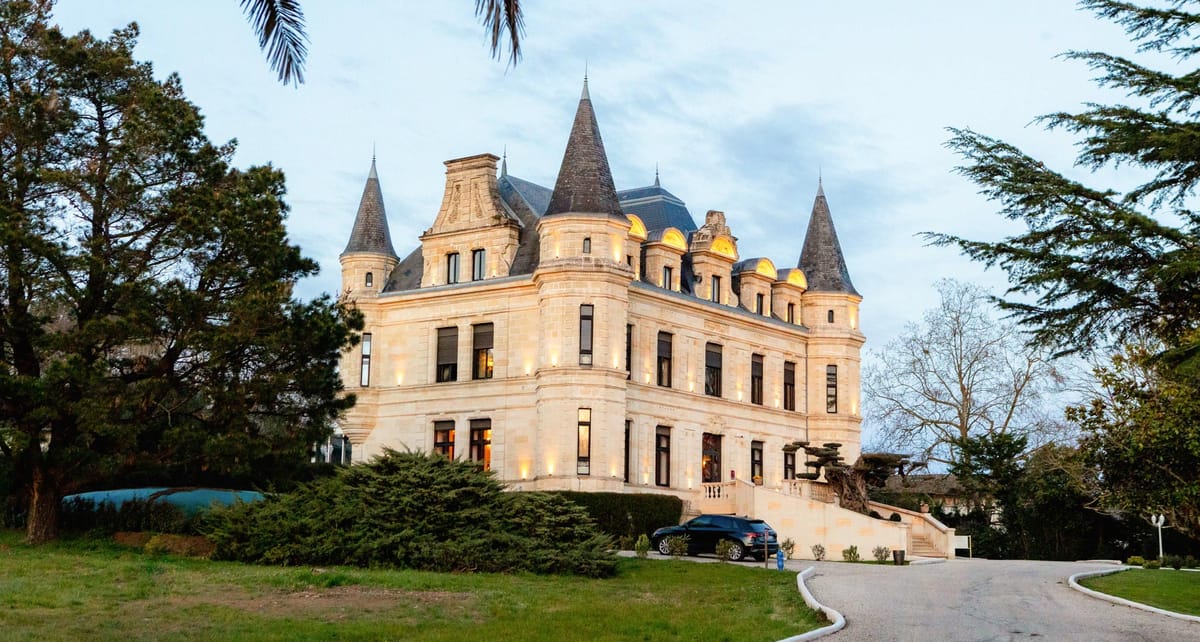
Château Camiac represents the French château at its most practically ready for a contemporary wedding: an 1834 estate in Bordeaux's Entre-Deux-Mers that completed a comprehensive two-year renovation in 2024, emerging with 20 modernised guest rooms, a bistronomic restaurant, and event facilities that meet the standard of a boutique hotel while preserving the period façade and vineyard landscape that define its château identity. The palm-lined avenue illuminated at night, estate lake, and fountain give the grounds the composed grandeur of a traditional Bordeaux property, while the 290-square-metre silhouette tent with parquet flooring and Napoleon chairs delivers a reception space with architectural polish.
Forty-nine guests sleep on-site, and an in-house chef serves regional Bordeaux cuisine through the on-site bistronomic restaurant. The heated pool terrace and tennis court give the weekend leisure structure. Bordeaux Saint-Jean is 25 minutes by car and the airport 45 minutes.
Why We Love It
A ground-up 2024 renovation means pristine 19th-century château architecture with genuinely modern comfort, set among Bordeaux vineyards.
Max Guests
200
Sleeps
49
Chapel
No
From €10,800PricingFrom €10,800•Estate Hire — €14,800/ venue hire
Château des Barrenques earns its place in a French château collection through an arboretum that functions as living architecture: over 52 tree species, including Giant Redwoods, Bald Cypresses, and 60 plane trees whose canopy forms what the estate calls its Natural Cathedral, an outdoor ceremony space with a living roof overhead that no interior hall can replicate. The 15th-century Provençal castle and the historic Magnanerie, a former silk house converted into multi-floor reception spaces, provide the period built fabric, while the arboretum gives the grounds a character as architecturally significant as the château itself. Art sculptures placed throughout the grounds and aromatic Provençal planting complete the estate's layered identity.
Fourteen bedrooms sleep 42 guests, and a 225-square-metre nomad tent provides al fresco dining or a rain backup with views of the park. The estate sits in the Vaucluse, 40 minutes from Avignon and close to Pont-Saint-Esprit and Bollène, where the local station is seven minutes away.
Why We Love It
A 15th-century Provençal castle where 52 tree species, a plane-tree cathedral alley, and a historic silk house create a living architectural landscape.
Max Guests
221
Sleeps
42
Chapel
No
From €10,000PricingFrom €10,000Peak season (June-September) exclusive venue hire for up to 200 guests, 2-night minimum stay/ venue hire
Château d'Aveny is an 18th-century château in the Vexin Natural Regional Park whose interior makes the strongest architectural case on this list for what the French château reception room should be: the Grande Galerie's 220 square metres of Hungarian Point parquet, crystal chandeliers, gilding, and mirrors set a standard that the building extends through a sequence of individually themed salons, the Salon des Oiseaux, Salon des Singes, Salon des Panthères, and Salle des Impressionnistes, each offering a distinct decorative world. The Grand Hall lobby, 160 square metres with a grand staircase, creates a formidable first impression for arriving guests. The château's silhouette, reminiscent of Cheverny in the Loire, is the exterior expression of these ornate interiors.
Thirty-four bedrooms sleep 94 guests, ample on-site accommodation for an international guest list. The six-hectare English-style park and Orangerie provide outdoor and additional indoor ceremony options. Fifteen minutes from Giverny.
Why We Love It
Thirty-four bedrooms, a 220-square-metre Grande Galerie with Hungarian Point parquet, and themed salons that give every room its own identity.
Max Guests
200
Sleeps
94
Chapel
No
From €11,500PricingFrom €11,500 · Hire + packagesPeak season (June-September) exclusive venue hire for up to 200 guests/ venue hire
Named for the peacock, Château de Paon is a 16th-century Provençal estate near Arles, expanded in the 19th century where the château's French heritage reveals itself through specific, irreplaceable details: wrought-iron gates opening onto a tree-lined drive; a turret housing the bridal suite bathroom; a centuries-old elm tree anchoring the French garden ceremony area; and a courtyard fountain setting the formal tone for outdoor dinners. A four-year restoration completed in 2022 preserved these original elements while modernising the 13-bedroom estate to current hospitality standards. The Grand Paon ballroom seats 100 for dinner, and the Petit Paon and Turret Bar provide intimate spaces for the evening's layered progression.
No curfew, external caterers welcome, no corkage, and the estate's Sustainable Collection certification reflect a venue that manages its French heritage with care. Twenty minutes from Nîmes and accessible via Nîmes Garons Airport and the Eurostar to Avignon.
Why We Love It
A 16th-century Provençal estate near Arles where a turret bathroom, courtyard fountain, and centuries-old elm give the château genuine architectural personality.
Max Guests
120
Sleeps
26
Chapel
No
From €5,450PricingFrom €5,450•3-Day / 2-Night Stay — €13,85012 rooms accommodation · Exclusive use of chateau•4-Day / 3-Night Stay — €15,95012 rooms accommodation · Exclusive use of chateau•4-Day / 3-Night Stay (Peak) — €19,10012 rooms accommodation · Exclusive use of chateau/ venue hire
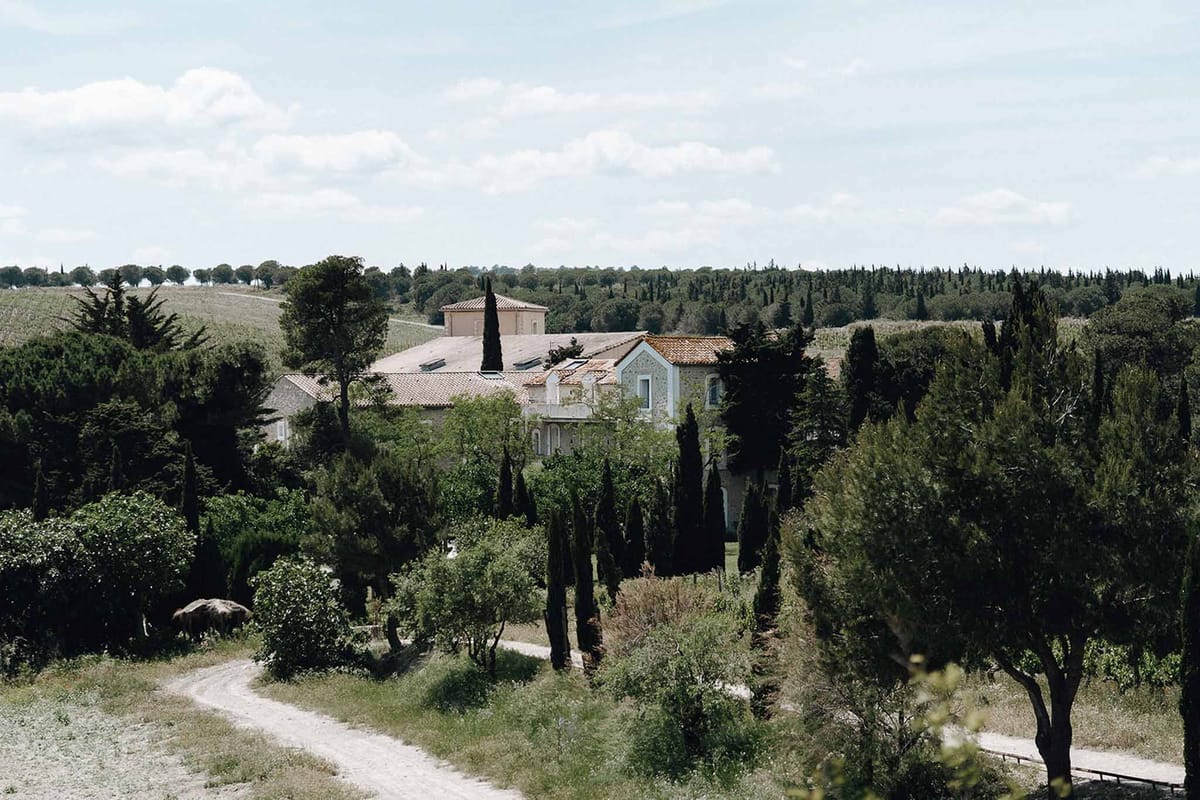
Château du Puits es Pratx carries a French château identity shaped by its Languedoc wine heritage rather than by aristocratic architecture: the château's inner courtyard, paved and candlelit around a central fountain beneath century-old stones, functions as the evening's main dining space, while the former wine cellar has been converted into a reception hall where the bar is built inside the original wine press. Built from local stone and shaped by viticulture, the property sits five minutes from the UNESCO-listed Canal du Midi in the Pays Cathar. The organic gardens and fragrant rose bushes extend the estate's working French heritage into the grounds.
The venue hosts up to 120 guests with 51 sleeping on-site in an all-inclusive three-night format. Ceremonies in the private vineyard under a natural arch place vows directly within the estate's wine-producing landscape. Carcassonne Airport is 40 minutes away.
Why We Love It
A Languedoc vineyard château where courtyard banquets, vineyard ceremonies, and the Canal du Midi five minutes away create a celebration unlike any other.
Max Guests
120
Sleeps
51
Chapel
No
From €19,119PricingFrom €19,119 · All-inclusivePeak season (June to September) 3-night wedding weekend with the whole estate, in-house chef and planner, plus on-site guest accommodation, which is part of the minimum package but priced separately./ venue hire
Château Lacanaud sits in the Dordogne wine region near Eymet, in the broader Périgord Pourpre stretch shaped by Bergerac vineyards. The château's local stone construction follows a Périgord building tradition shaped by the terrain and climate over centuries, and the formal gardens, lakes, and woodland paths on the 20-acre estate create outdoor ceremony and cocktail settings where the French countryside does the architectural work. The saltwater infinity pool anchors next-day gatherings looking out over the surrounding parkland.
Full private hire with on-site accommodation. The medieval villages of Issigeac and La Roque Gageac, and Bergerac wines give the wedding weekend a culinary and cultural depth specific to this corner of French château country. Bergerac Airport is 25 minutes away.
Why We Love It
A 20-acre Dordogne wine country estate where saltwater infinity pool, Bergerac terroir, and deep seclusion define the château experience.
Max Guests
100
Sleeps
23
Chapel
No
From €12,000PricingFrom €12,000 · Hire + packagesPeak season (June-September) exclusive chateau hire with accommodation for up to 23 guests, 20-acre estate/ venue hire
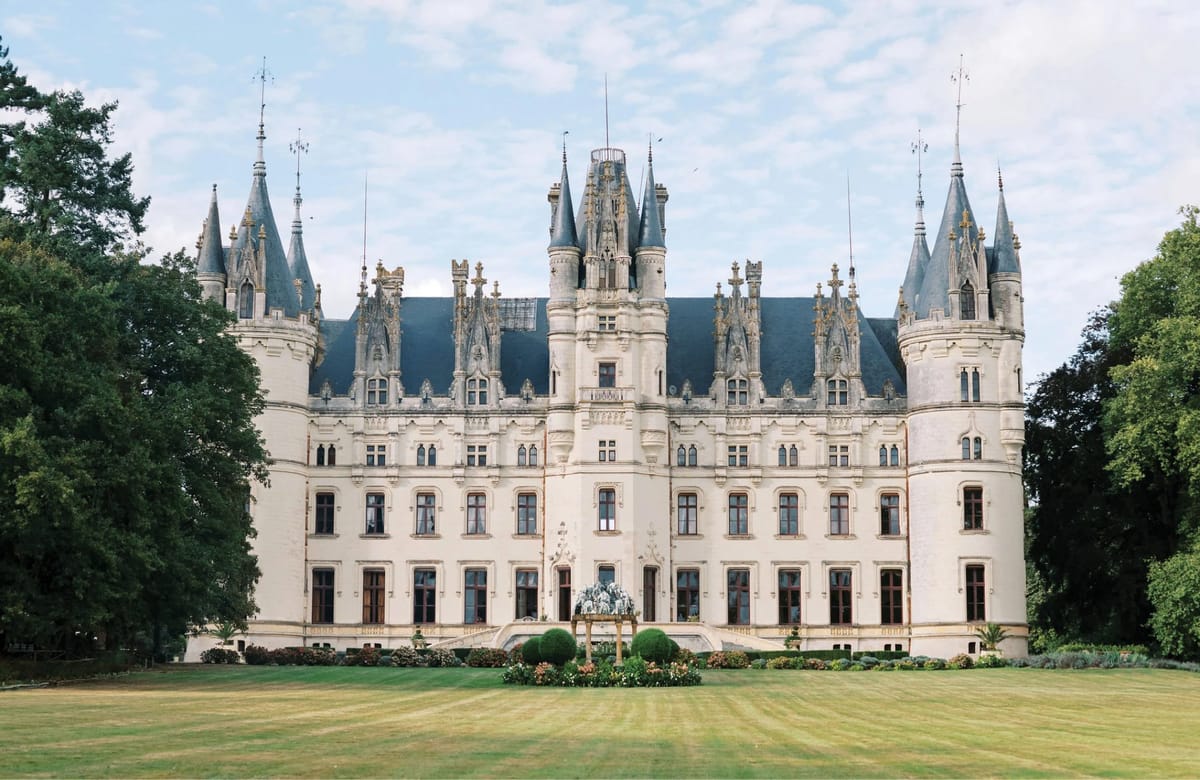
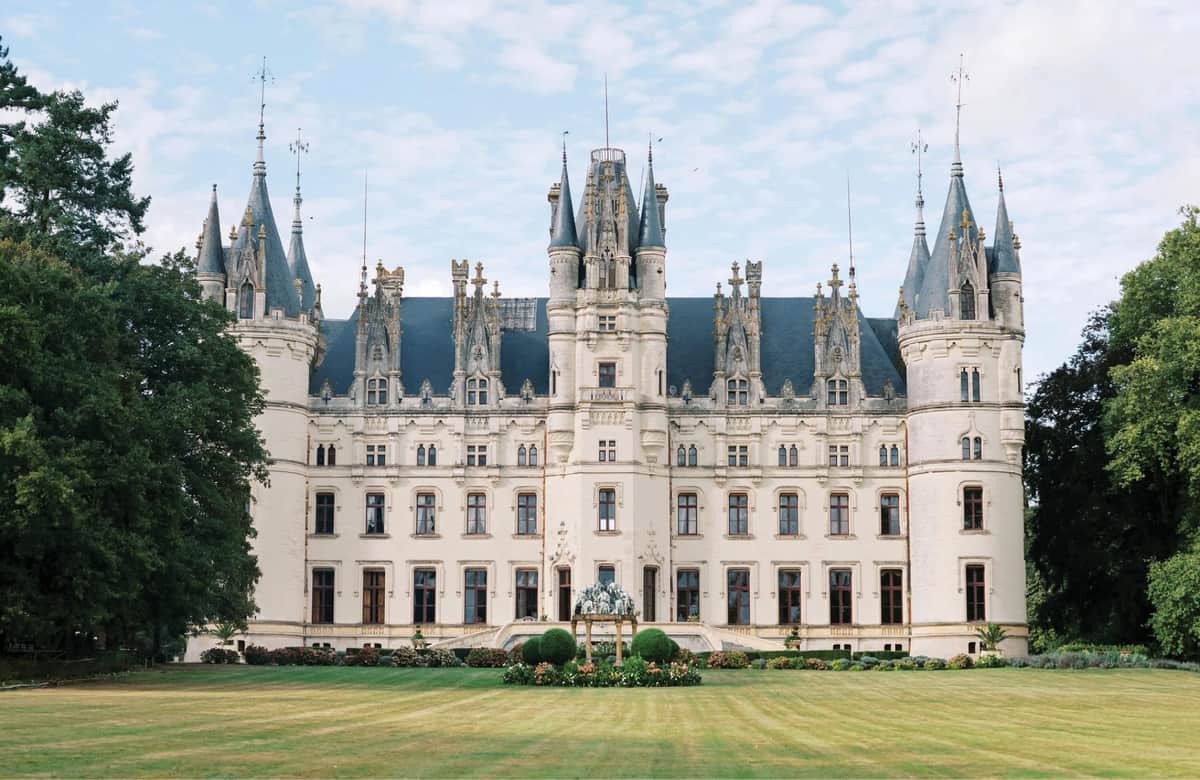
Château Challain is the most overtly theatrical château: a Neo-Gothic castle built in 1854 with pointed arches, pinnacled towers, and tracery windows that belong to the same architectural vocabulary as Notre-Dame and Sainte-Chapelle, translated into a private Loire Valley residence. The 21 suites are each decorated in a distinct period style, which means the bridal suite, the parents' room, and the best man's quarters all have their own identity rather than a uniform hotel look. The on-site chapel provides a ceremony setting within the building itself, with stone vaulting and stained glass that make the religious or symbolic service part of the architecture rather than something staged in a garden.
With capacity for 120 guests and 50 sleeping on-site, the scale supports a full weekend without the estate feeling under-used or overcrowded. In-house catering and full-service wedding packages mean the château's team handles coordination rather than requiring couples to assemble suppliers independently. The estate sits 50 minutes from Nantes, with direct TGV connections to Paris, and the surrounding Loire Valley provides the wine, food, and cultural context that define the region's château heritage.
Why We Love It
A Neo-Gothic castle with on-site chapel, 21 individually styled suites, and full-service packages that handle every detail in-house.
Château Gassies occupies a position that sets it apart from every other château: the heights of Latresne, overlooking both Bordeaux and the Garonne River from an 18th-century estate spread across 14 hectares. That proximity to a major city, just five minutes from Bordeaux centre, is unusual for a château wedding venue and gives the property a dual identity as both a countryside estate and an urban-adjacent celebration space. The 18th-century architecture carries the measured proportions and symmetry of its period, with formal façades and grounds that reflect the restrained Bordelais style rather than the Loire's decorative excess.
Six suites and three independent guesthouses accommodate 43 guests across the estate, and the distributed layout gives overnight visitors a sense of privacy within the larger property. Exclusive use for up to 150 guests means the grounds, reception rooms, and wide-format views over the Garonne are reserved entirely for one celebration. The Bordeaux wine region on the doorstep provides a cultural programme for the wider weekend that few château locations can match.
Why We Love It
An 18th-century estate on the heights above the Garonne with wide-format views over Bordeaux, five minutes from the city centre.
Château les Crostes is defined by its scale. At 200 hectares, including 55 hectares of producing vineyards under the Provence appellation, this 17th-century estate near Lorgues in the Var is one of the largest estates in this collection. The land was once held by the Comte de Ramatuelle, and today the estate operates as a working vineyard with olive groves, a lily-covered lake, formal gardens, and lawns spreading across the grounds. The sheer acreage means wedding celebrations occupy a fraction of the estate, creating a sense of seclusion that smaller properties cannot achieve.
Twelve rooms sleep 28 guests, and celebrations accommodate up to 150 with full private hire. Free-choice catering allows couples to bring in Provençal specialists, and there is no curfew. The lily-covered lake and park provide outdoor ceremony locations, while the pool and spa offer leisure options for guests staying the weekend. Starting from €12,000, the combination of 200 hectares, a producing vineyard, and Provence appellation wines makes this the strongest value proposition for a large-estate vineyard château.
Why We Love It
A 200-hectare Provençal vineyard estate with 55 hectares under production, a lily-covered lake, and no curfew, from just €12,000.
Max Guests
150
Sleeps
28
Chapel
No
From €14,000PricingFrom €14,000 · Hire + packagesPeak season (June-September) exclusive 200-hectare estate hire with accommodation for 28 guests, 2-night minimum/ venue hire
Château de Vauchelles is a listed Monument Historique of the 17th and 18th centuries, its brick and stone façade set behind 25 hectares of formal gardens in the Somme. The wedding offer uses the estate as a whole rather than a single room: the 350 m2 Orangery seats 190, the Ballroom takes ceiling drapes, and the Galerie Anglaise gives 160 m2 of covered space at the end of the English Garden when the weather turns. Hire is full privatisation across the weekend with no curfew, and 22 bedrooms sleep 62 guests on site, so the celebration does not stop for a transfer to hotels. For couples travelling from Britain the position is practical as well as scenic: about 1h20 by road from the Calais Eurotunnel terminal and 1h30 from Paris Charles de Gaulle.
Why We Love It
Seventeenth and eighteenth-century listed heritage, 25 hectares of formal gardens, and the whole estate privatised for the weekend.
Max Guests
190
Sleeps
62
Chapel
No
From €9,500PricingFrom €9,500Peak season (June-September) exclusive venue hire for up to 190 guests/ venue hire
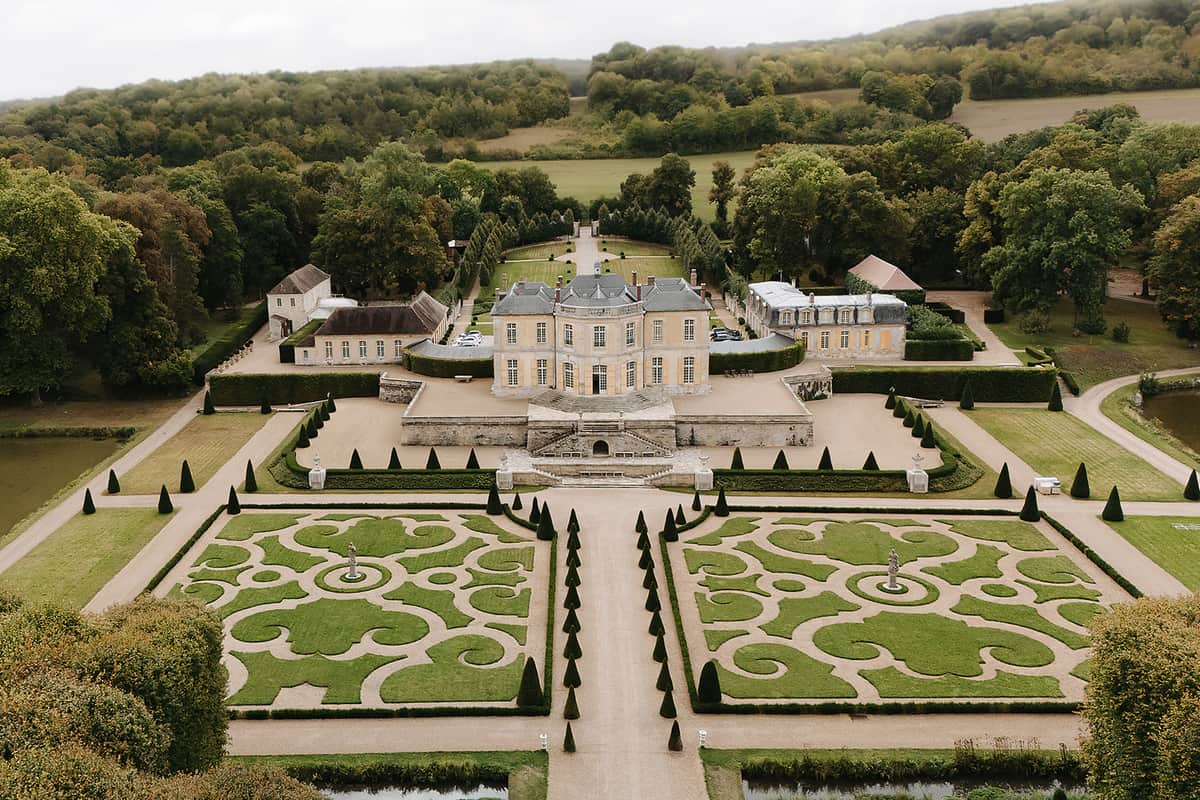
Château de Vitry-la-Ville carries a French château credential that is almost impossible to replicate: French gardens designed by André Le Nôtre, the landscape architect behind the gardens of Versailles and Vaux-le-Vicomte, laid out across a 17-hectare estate in the Champagne region. The Le Nôtre connection places this château in a specific tradition of formal garden design where the grounds are conceived as a continuation of the building's architecture, with symmetrical parterres, structured sightlines, and reflective creeks and ponds threading through the estate. In the world of French château heritage, sharing a landscape pedigree with Versailles is a distinction that speaks for itself.
The Champagne region location adds a further layer of French cultural identity, with the area's celebrated houses and vineyards within easy reach for guest tastings and excursions. The 17-hectare grounds give generous space for outdoor ceremonies and marquee reception settings within the designed Le Nôtre landscape.
Why We Love It
André Le Nôtre-designed gardens on a 17-hectare Champagne estate bring the same classical landscape pedigree as Versailles to a wedding setting.
Max Guests
200
Sleeps
35
Chapel
Yes
From €3,000PricingFrom €3,000Peak season (June-September) exclusive venue hire for up to 200 guests, 1-night minimum stay/ venue hire
Château du Pordor is a 13th-century medieval seat classified as a Monument Historique, set above the Vilaine River valley in Loire-Atlantique on the border of Brittany. The distinguishing architectural feature is the open-roof medieval chapel where ceremonies take place under open sky within ancient stone walls, a ceremony setting no other château in this collection can offer. Stone-built reception rooms in the oldest part of the castle preserve three of the four original medieval beams and host dinners in the Main Banquet Hall, Salon Rouge, and Salon Privé, while a 19th-century stable converted into a Theatre-Ballroom extends celebrations into the evening.
Eleven bedrooms sleep 30 on-site, and the estate hosts up to 130 guests across 30 hectares of parkland with a cocktail terrace overlooking the lake. Starting from €11,500, the whole estate is held privately for the weekend. Nantes Atlantique Airport and Redon station bring Paris within two hours by TGV.
Why We Love It
A 13th-century Monument Historique in the Vilaine valley where ceremonies take place under open sky in the château's original roofless stone chapel.
Max Guests
130
Sleeps
30
Chapel
Yes
From €11,500PricingFrom €11,500 · Hire + packages•Exclusive Wedding Weekend — €11,500Exclusive use of the estate for 2 days · Accommodation for up to 30 guests for 1 night · A dedicated wedding coordinator · +2 more•Premium Wedding Weekend — €12,500Everything in the Exclusive Wedding Weekend · Exclusive use of the estate for 3 days · Accommodation for up to 30 guests for 2 nights · +1 more•Royal Wedding Weekend — €15,000Everything in the Premium Wedding Weekend · An in-house DJ · Use of the historic chapel for the ceremony · +1 more/ venue hire
Château de Sansé carries the golden stone and vineyard-framed silhouette that places it squarely in the Bordeaux château tradition, 20 minutes from Saint-Émilion's medieval cellars and UNESCO-listed streets. Built in the 16th century, the property operates as a château-hotel with an all-inclusive three-night format: welcome dinner, in-house chef catering built on bistronomic Gironde-region cuisine using local and seasonal ingredients, and a day-after pool party with BBQ. The structured package removes the complexity of assembling separate suppliers, letting the château's own kitchen team deliver a menu rooted in the surrounding wine country's produce.
Sixteen ensuite rooms sleep 32 guests, and the landscaped gardens and cypress-lined pathways are characteristic of Bordeaux estate architecture. The heated pool anchors the morning-after gathering, and cooking workshops, a helipad, and a fishing lake extend the weekend programme. Bergerac Airport is 35 minutes away and Bordeaux Airport 50 minutes, keeping the château accessible from major European hubs despite its position deep in the Gironde countryside.
Why We Love It
A 16th-century golden stone château-hotel near Saint-Émilion, where a three-night all-inclusive package brings Gironde wine-country cuisine to every meal.
Max Guests
120
Sleeps
32
Chapel
No
From €10,355PricingFrom €10,355 · Hire + packages•2-Night Wedding Package — €10,355Multi-day exclusive use (2 nights) · Catering on all days with seasonal and local products · Night before meal for all guests staying on site · +2 more•3-Night Wedding Package — €11,355Multi-day exclusive use (3 nights) · Catering on all days with seasonal and local products · Night before meal for all guests staying on site · +2 more/ venue hire
Château de Saint-Martory stakes its château credentials on its setting: a Renaissance castle on 40 hectares of woodland in the Garonne River valley, with direct views of the Pyrenees mountains, framing the estate as Toulouse's gateway into the high peaks. A massive walnut tree stands in front of the château as the signature ceremony and cocktail location, one of six distinct spaces across the property that include a riverside ceremony point with Pyrenees panoramas, a central woodland alley, a historic wood barn for dancing and dining, a 19th-century farmhouse converted for indoor receptions, and a festoon-lit main courtyard.
Exclusive use covers the full estate for up to 120 guests. The privatisation includes the chateau, gatehouse and farmhouse (11 bedrooms sleeping 24 adults), and the Relais du Château in the village and the Artist House in the château's woodland can be rented alongside, bringing the total to 42 adults plus children. The privatisation is sold as a 3-night package, so the celebration settles into the landscape rather than compressing into a day. Toulouse International Airport is under an hour away.
Why We Love It
A Renaissance castle with Pyrenees views across 40 hectares of Garonne woodland, where a massive walnut tree anchors outdoor ceremonies in front of the château.
Max Guests
120
Sleeps
42
Chapel
No
From €17,400PricingFrom €17,400 · Hire + packages•Wedding Package - Up to 30 guests — €4,800Wedding manager assistance from booking through wedding day · Vendor recommendation and coordination · Exclusive use of reception spaces (indoor and outdoor) · +5 more•Wedding Package - 31 to 60 guests — €6,200Wedding manager assistance from booking through wedding day · Vendor recommendation and coordination · Exclusive use of reception spaces (indoor and outdoor) · +5 more•Wedding Package - 61 to 90 guests — €7,600Wedding manager assistance from booking through wedding day · Vendor recommendation and coordination · Exclusive use of reception spaces (indoor and outdoor) · +5 moreSee full pricing →/ venue hire
Château de l'Hospital is a classified Monument Historique built by the architect Victor Louis in the Graves wine country, 24 kilometres south of Bordeaux. A walled four-hectare estate wraps an organic vineyard around the château, giving the grounds a working wine-country setting for ceremonies and outdoor dinners.
The estate offers full privatisation, seating 120 guests and sleeping 49 across 11 bedrooms, so the wedding party stays on site within the walls. Its position in the Graves appellation places the Bordeaux vineyards and the city within easy reach for the wider weekend. Starting from €9,000.
Why We Love It
A classified Monument Historique in the Graves vineyards south of Bordeaux, walled and privatised, where an organic vineyard frames the celebration.
Max Guests
120
Sleeps
49
Chapel
No
From €9,000PricingFrom €9,000From EUR 9,000 for a one-night weeknight privatisation (Tuesday to Wednesday) with on-site accommodation. The full Friday-to-Monday weekend, also including accommodation, is EUR 16,400./ venue hire
Château du Terral is a neo-Renaissance château built between 1889 and 1909 in the heart of the Minervois wine region. The architecture carries the ornament and symmetry of the period, and 11 hectares of listed gardens with vineyards and olive groves give the grounds a structured Languedoc character.
A private chapel on the estate provides a ceremony setting within the grounds, and the château hosts all-inclusive celebrations on a sole-use basis with on-site accommodation for 25 guests. The surrounding Minervois vineyards and wider Occitanie wine country frame the weekend. Starting from €11,500.
Why We Love It
A neo-Renaissance Minervois château with a private chapel and 11 hectares of listed gardens, vineyards, and olive groves.
Max Guests
350
Sleeps
25
Chapel
Yes
From €11,500PricingFrom €11,500 · All-inclusive•Weekend Estate Hire — €11,500Exclusive use of the estate from Friday 4pm to Sunday 5pm · Use of the grounds for ceremony · Access to the chapel for intimate ceremony (30 people) · +5 more/ venue hire
Château de la Faye is a Charente château hired whole for 3-day weddings, set on 500 hectares of forest, ponds and open country around an 8-hectare lake. The village church stands a few metres beyond the château gates for couples planning a religious ceremony, as there is no chapel on the estate itself. Up to 95 guests dine inside the château, and 27 stay on site for the weekend.
Why We Love It
A Charente château on 500 hectares of forest and ponds, with the village church a few metres beyond its gates.
Max Guests
95
Sleeps
27
Chapel
No
From €7,225PricingFrom €7,225 · Venue hire only•Third night (2027) — €1,600A 20% discount on the nightly rate · Exclusive use of the estate and its accommodation for a further night•Weekday hire, May to September (2027) — €8,455Sole use of the chateau grounds and terrace · Reception hall from 10:00 the day before, with adjoining catering preparation area · Accommodation for 27 guests over 2 nights · +5 more•Weekend hire, May to September (2027) — €9,950Sole use of the chateau grounds and terrace · Reception hall from 10:00 the day before, with adjoining catering preparation area · Accommodation for 27 guests over 2 nights · +5 moreSee full pricing →/ venue hire
Aix-en-Provence (20 minutes by car), Bouches-du-Rhône
Château de Fonscolombe is a classified Monument Historique and the only property operating as a 5-star Relais & Châteaux hotel. The 18th-century château sits within 12 hectares of listed parkland in the Pays d'Aix, 20 minutes from Aix-en-Provence, with century-old cedars, plane trees, fountains, and Provençal gardens forming the outdoor framework. Six classified salons preserve the interior character of the Marquis de Saporta's original residence. The on-site chapel provides a religious ceremony option within the building, while the South Park seats 200 for outdoor dining beneath the listed tree canopy (140 indoors).
Fifty rooms accommodate 110 guests, and full privatisation is mandatory, starting from €34,000 per night including rooms, breakfasts, and tourist tax. Chef Marc Fontanne runs La Table de l'Orangerie, which holds one Michelin star and one Michelin Key (2025), bringing Provençal gastronomy with seasonal, locally sourced ingredients to the wedding menu. The estate produces its own wines under the Coteaux d'Aix-en-Provence AOC. The bridal suite, Suite Prestige, hosted the Queen Mother of England in 1965.
Why We Love It
A classified Monument Historique with Michelin-starred dining, 50 rooms, its own AOC vineyard, and 12 hectares of listed Provençal parkland.
Max Guests
140
Sleeps
110
Chapel
Yes
From €34,000PricingFrom €34,000 · Hire + packagesPeak season (June-September), exclusive venue hire for up to 140 guests with a minimum 2-night stay./ venue hire
Château Bouffemont sits within the Montmorency Forest, 30 kilometres north of Paris, a proximity to the capital that no other château can match. Built in the 19th century for the Marquise of Preignes and later owned by Baron Empain, the property preserves the period's taste for theatrical interiors: five-metre ceilings throughout, crystal chandeliers in the Grand Salon, hand-carved wooden panels and deep red silk wall-covering in the Salon du Baron, amethyst crystal chandeliers in the Salon de la Marquise, and a monumental exterior staircase leading to the terrace with wide forest views. The Dandy Lounge, with its Chesterfield sofas and industrial-modernist objects, provides a counterpoint to the classical rooms.
Nine bedrooms sleep 30 guests, and celebrations accommodate 2 to 150, making it one of the few châteaux on this list that genuinely welcomes elopements and micro-weddings alongside full-scale events. Late curfew, sole-use of the five-hectare estate, and a recommended caterer list rather than mandatory in-house dining. Three hectares of formal gardens with century-old trees and a fountain provide outdoor ceremony and cocktail settings. Starting from €8,500, an accessible entry point for a Paris-region château.
Why We Love It
A 19th-century château 30 km from Paris with five-metre ceilings, late curfew, and an accessible Paris-region starting price.
Max Guests
150
Sleeps
30
Chapel
No
From €8,500PricingFrom €8,500 · All-inclusivePeak season (June-September), venue hire for up to 150 guests with overnight stay./ venue hire
Château de Villette is an 18th-century estate in the Île-de-France, roughly 40 minutes from central Paris, designed by Mansart and set within formal French gardens, parkland, and an in-house chef-led service. The architecture carries the measured proportions and symmetry of the period, with grand salons, library, and manicured grounds. Sole-use of the estate means your party has the full château for the duration, creating an atmosphere closer to a private house party than a hired venue.
The château accommodates up to 23 guests sleeping on-site for intimate weddings, with outdoor capacity scaling for larger ceremonies in the formal garden, where the château façade serves as a backdrop and the interior salons host dinners with period furnishings and candlelight. Swimming pool on-site. Starting from €25,000 with the full property reserved. For couples who want a grand French château experience at an intimate scale within easy reach of Paris, Villette proves that the smallest guest lists can occupy the most significant properties.
Why We Love It
A Mansart-designed château in the Île-de-France with formal gardens, in-house chef, and an intimate scale just 40 minutes from Paris.
Max Guests
500
Sleeps
23
Chapel
No
From €25,000PricingFrom €25,000 · Hire + packagesPeak season (June-September), venue hire with catering options for up to 500 guests./ venue hire
Château la Durantie was built in 1840 as the private residence of the Duke of Isly, and the building carries the proportions and formality of that commission: high ceilings, reception rooms with antique furnishings, and a grand dining room that reflects the 19th-century aristocratic programme. The five-hectare enclosed park provides a contained garden setting, with outdoor ceremonies held on the grounds and a permanent marquee with wooden dancefloor, chandeliers, and tented roof seating 150 for the reception dinner.
Twenty-one bedrooms accommodate 40 guests overnight, and the property offers full sole-use weekend hire with a recommended caterer list for classical French cuisine using seasonal Dordogne produce. The heated swimming pool anchors the morning-after programme. Situated in the Périgord, the surrounding Dordogne countryside, with its medieval villages, truffle markets, and riverside scenery, provides the cultural and culinary context for the wedding weekend. Limoges Airport is one hour away. Starting from €18,000.
Why We Love It
A Duke's 1840 residence in the Dordogne with 21 bedrooms, a permanent marquee for 150, and the Périgord's culinary heritage on the doorstep.
Max Guests
150
Sleeps
40
Chapel
No
From €18,000PricingFrom €18,000 · All-inclusivePeak season (June-September) exclusive venue hire for up to 150 guests, minimum 3 nights/ venue hire
Château de Malliac draws its architectural character from a source not found elsewhere: two restored Armagnac chai buildings, the former spirit-ageing warehouses that define Gascony's distilling heritage. La Salle des Mariés de Venise and Le Verger des Jalousies both feature massive beamed ceilings, ancient stone walls, and acoustics shaped by centuries of barrel storage. These are reception halls with an industrial agricultural beauty that conventional château salons cannot replicate. The 12th-century origins make this one of the oldest properties in the collection, and the estate's four hectares include a Cour d'Honneur, a South Park shaded by century-old trees and bordered by vineyards, a rosary garden, and secret paths through the grounds.
On-site accommodation sleeps 62 guests, and the estate handles celebrations of up to 500 with full private hire. Free-choice catering and the estate's own Gascony wines, Vignes de Victoire in white and red, reserved exclusively for property visitors, give couples both flexibility and a distinctive wine pairing. Four outdoor ceremony locations, including the Cour d'Honneur and rosary garden, provide distinct settings. Agen is 45 minutes away. Starting from €10,150.
Why We Love It
A 12th-century Gascon estate where two restored Armagnac chai halls deliver reception spaces with a character no conventional château salon can match.
Max Guests
500
Sleeps
62
Chapel
No
From €10,150PricingFrom €10,150Peak season (June-September) exclusive venue hire for up to 500 guests, minimum 2 nights/ venue hire
Château de Puy Robert is a 19th-century Directoire-style château in the heart of the Périgord Noir, 700 metres from the Grotte de Lascaux IV. A ten-hectare wooded park surrounds the château, giving the grounds privacy and a green backdrop for outdoor ceremonies.
Run as a château-hotel, the estate offers exclusive use for weddings of up to 130 guests with on-site accommodation for up to 120. The Dordogne's prehistoric sites, medieval villages, and river scenery give the wider weekend its setting. Starting from €6,500.
Why We Love It
A Directoire-style château-hotel in the Périgord Noir, metres from Lascaux IV, with exclusive use and accommodation for up to 120.
Max Guests
130
Sleeps
120
Chapel
No
From €6,500PricingFrom €6,500 · Hire + packagesStarting price for venue hire./ venue hire
Château du Raysse is a medieval château dating back to 1155 in the Dordogne valley, with the stone fabric and long lineage of a property held across centuries. The grounds and two swimming pools give the estate space for outdoor ceremonies and relaxed day-after gatherings.
The château offers whole-estate private hire for up to 100 guests, with 38 sleeping on site across 17 bedrooms, so a large share of the party stays within the estate. The surrounding Dordogne countryside, with its medieval villages and river scenery, frames the wider weekend. Starting from €9,500.
Why We Love It
A medieval Dordogne château dating to 1155 with two swimming pools, exclusive hire, and 17 bedrooms sleeping 38 on site.
Max Guests
90
Sleeps
38
Chapel
No
From €9,500PricingFrom €9,500Peak season (June-September) exclusive venue hire for up to 90 guests, minimum 3 nights/ venue hire
Château Hermitage de Combas is a 75-hectare estate set among vineyards in Occitanie, where a renovated 19th-century wine cellar now serves as the reception hall. The working-vineyard setting and the converted cellar give the celebration an agricultural Languedoc character rather than a formal one.
The reception hall seats up to 300 guests, and the estate sleeps up to 132 on site across 27 apartments and suites, so even a large guest list can stay within the property. Exclusive use is available for couples who want the estate to themselves. Starting from €16,000.
Why We Love It
A 75-hectare Occitanie vineyard estate where a renovated 19th-century wine cellar hosts up to 300 guests, with 27 apartments and suites on site.
Max Guests
300
Sleeps
140
Chapel
Yes
From €16,000PricingFrom €16,000 · Hire + packagesPeak season (June-September) exclusive venue hire for up to 300 guests, minimum 2 nights/ venue hire
Château l'Hospitalet is a five-star wine resort spanning 1,000 hectares near Narbonne on the Mediterranean coast. A working wine estate with a private beach, a Michelin Green Star restaurant, and a spa, it pairs a coastal vineyard setting with full resort facilities.
The resort runs all-inclusive celebrations for up to 300 guests, with 41 rooms and suites on site for the couple and their guests. Its coastal Languedoc position brings beach, vineyard, and sea into one estate for the weekend. Starting from €15,000.
Why We Love It
A five-star Mediterranean wine resort near Narbonne with a private beach, Michelin Green Star dining, and 41 rooms across 1,000 hectares.
Max Guests
300
Sleeps
82
Chapel
No
From €15,000PricingFrom €15,000 · All-inclusivePeak season (June-September) all-inclusive wedding package for up to 300 guests, minimum 2 nights/ venue hire
Châteaux are not one register, and the differences shape the day more than a building's age does.
Across Provence and Occitanie, the southern wine châteaux come with vineyard or olive-grove grounds, a pool, and outdoor ceremony space. They suit a warm-season celebration with golden light and a relaxed estate feel.
In the Loire and Nouvelle-Aquitaine, the garden châteaux are the classic château silhouette: formal façades, ornamental gardens, a grand and ceremonial look.
The Paris-regionchâteaux, in Île-de-France, sit closest to the international airports, with formal interiors to match. If your guests are flying in, this is the shortest hop from Paris.
Further afield, châteaux in the Champagne region pair the wedding weekend with the area's own vineyards, while the Dordogne often delivers a similar formal look at a gentler price point, with a concentration of Monument Historique-listed architecture.
Scale matters as much as style. Match the estate to your guest count rather than paying for grandeur you will not fill; the best-value fit is usually the smallest estate that still seats everyone comfortably.
Expert advice
Expert Tips for This Style
Decide your catering model before you fall for a venue
The catering model shapes your budget and your creative freedom more than the headline hire fee does. Estates fall into three types: in-house catering, a fixed recommended-supplier list, or your own external caterer. An exclusive-use estate that looks costly on paper can work out lower per guest once catering, rentals, and accommodation are counted in, while a low dry-hire figure climbs once those extras are added.
Can foreign couples legally marry in a French château?+
In practice, most couples do not hold the legal marriage at the château. French law recognises only a civil marriage at a town hall (mairie). According to service-public.fr, that requires at least one partner to have lived in the commune for 40 continuous days first, which is impractical for couples travelling from abroad. The common route is to complete the legal civil marriage at home and hold a symbolic ceremony at the château. Full steps are in our guide to getting married legally in France.
Do château venues require exclusive, whole-estate hire?+
Most do. A château is typically let on a whole-estate basis, often as a multi-day hire rather than a single day. That gives you sole run of the house and grounds, the ceremony and reception spaces, and on-site overnight accommodation.
What drives the cost of a château wedding?+
The two biggest levers are whether you hire the estate dry (venue only) or all-inclusive, and the catering model: in-house, a recommended-supplier list, or an external caterer billed per head. Catering is the largest line after the venue itself. Season and mid-week versus weekend dates also move the figure.
How many guests can a château hold, and where do extra guests sleep?+
Celebration capacity and sleeping capacity are not the same number. An estate that seats 150 for dinner may sleep far fewer on site, so couples commonly house the overflow at nearby hotels and run shuttles. Plan the bed count and transport early, not as an afterthought.
When is the best time of year for a château wedding?+
May to September is peak for weather and demand. Shoulder months like April and October, along with mid-week dates, bring lower pricing, better availability, and easier access to in-demand photographers and suppliers.
What is the difference between a château and a domaine?+
The distinction is architectural, not a ranking of one over the other. A château centres on a single grand building, a former noble residence or fortified manor, so the ceremony and reception happen in or immediately around that one historic structure. A domaine is a working estate, often a main house alongside barns, outbuildings, or vineyard structures spread across the grounds, so the day can move between several buildings rather than one. Some properties use both words in their own marketing; the test is whether a single dominant building anchors the estate, or whether the grounds and outbuildings are the draw.
Do I need a wedding planner for a château wedding?+
Most couples planning from abroad use one, even at châteaux with an in-house coordinator. The in-house team runs the building and grounds; a planner covers everything outside that remit: supplier sourcing, French paperwork, guest logistics, and the day-of timeline if the legal civil marriage happens elsewhere. Browse vetted planners and other suppliers in our wedding vendor directory.
What does a château wedding package typically cost to start?+
Entry pricing spans a wide range. Some estates can be hired dry, ceremony space and grounds only, from under 5,000 euros, while a fully staffed all-inclusive château runs from 15,000 euros into six figures for the largest weekend events. That entry figure is the venue-hire starting price, not the total wedding cost.